Home

/

Symptoms

/

Abdominal Pain

Can signal something serious

Abdominal Pain

Location matters more than severity. Where it hurts is the single most useful piece of information.

stomach pain, tummy ache, gut pain, pain in belly, stomach ache

£40 · 20 minutes

Same-day availability

Assessed by a GMC-registered GP, not a symptom checker

Honest about what needs to be seen in person

Tests and referrals arranged where they are needed

Your NHS records in the room, with your consent

Clinically reviewed by Dr Mohammad Khan · Last reviewed

August 23, 2026

Book a consultation

A 20-minute appointment with a GMC-registered GP for £40. Same-day appointments are usually available, 6am to 10pm, seven days a week.

Private GP care led personally by Dr Mohammad Zubair Khan, GMC 7563469.

Why patients choose Cheshire Clinics

GMC registered doctors badge - every Cheshire Clinics consultation is with a General Medical Council registered GP

GMC-registered

Care led personally by Dr Khan

Royal College of General Practitioners badge - RCGP trained private GP consultations at Cheshire Clinics

RCGP-trained

Attentive, unhurried care that listens properly

Google five star reviews badge - Cheshire Clinics private GP online

Highly rated by patients

Five-star Google reviews from the people we have looked after

Care Quality Commission registered badge - Cheshire Clinics online GP service is registered with the CQC, England's independent regulator of health and social care

CQC-registered

Registered with the Care Quality Commission

Same-Day Appointments
Sick Notes
Private Prescriptions
Blood Tests
Menopause & HRT
Weight Management
Mental Health
Specialist Referrals
Same-Day Appointments
Sick Notes
Private Prescriptions
Blood Tests
Menopause & HRT
Weight Management
Mental Health
Specialist Referrals
Important

When to get urgent help

Go to A&E or call 999 for:

  • Sudden severe abdominal pain, particularly if the abdomen is rigid or extremely tender to touch
  • Pain with vomiting and inability to pass wind or stool
  • Pain with a high fever
  • Pain with vomiting blood, or black tarry stools
  • Severe pain with a positive pregnancy test — ectopic pregnancy is an emergency
  • Pain radiating to the back with collapse or feeling faint
  • Testicular pain with abdominal pain in a young man

Sudden severe abdominal pain is one of the presentations where remote assessment is least appropriate. Please do not wait for an appointment.

Overview

Abdominal pain covers everything from trapped wind to a surgical emergency, and severity alone is a poor guide — trapped wind can be agonising while a serious problem can start mildly.

Location is the most useful single piece of information, followed by what the pain does over time and what comes with it.

What it could be

Upper abdomenreflux, indigestion and ulcers centrally; gallstones on the right, classically after fatty food; pancreatitis, boring through to the back.

Lower abdomenurinary infection; constipation; diverticulitis on the left; appendicitis, classically starting centrally and moving to the right.

Pelvic, in womenperiod pain, endometriosis, ovarian cysts, and pelvic inflammatory disease. Always consider pregnancy.

Anywhere, and coming and goingIBS is the commonest cause of recurrent abdominal pain and is characteristically relieved by opening the bowels. Coeliac disease and inflammatory bowel disease also present this way.

What you can do now

Point to it, and note whether it has moved

Where the pain is, and where it started, does more diagnostic work than almost anything else.

  • Started vaguely around the navel and settled into the lower right over some hours — this is the classic appendicitis pattern, and it is worth recognising because the early stage is so easily dismissed as indigestion
  • Upper right, coming in waves after fatty food, spreading to the right shoulder blade — gallbladder
  • Loin, coming in severe waves down towards the groin, unable to keep still — kidney stone
  • Upper middle, burning, related to meals or lying flat — stomach or reflux
  • Lower, on one side, in anyone who could be pregnant — see below, this is urgent

Notice how you are holding yourself

This one observation separates two very different situations:

  • Lying absolutely still because any movement hurts — suggests inflammation of the abdominal lining, and is a surgical presentation
  • Rolling about, unable to get comfortable, pain coming in waves — suggests a blocked tube: a stone, or gut colic

Anyone who could be pregnant, with lower abdominal pain

Do a pregnancy test today. Not next week, not after the pain has settled.

An ectopic pregnancy causes one-sided lower abdominal pain and can be life-threatening, and it frequently presents before anyone suspects a pregnancy at all. A positive test with one-sided pain is an emergency — go to A&E or an early pregnancy unit the same day.

What not to take

  • Do not take laxatives if you have not passed wind, are vomiting, and your abdomen is swollen and tight. That combination suggests obstruction, where laxatives are actively harmful
  • Avoid ibuprofen and other anti-inflammatories if the pain is upper and burning — they worsen gastritis and ulcers
  • Avoid codeine, which slows the bowel and clouds the picture
  • Do not put a hot water bottle on severe, undiagnosed abdominal pain. It is comforting for period pain and muscular ache; it is not appropriate where inflammation such as appendicitis is possible

Paracetamol is reasonable, and does not mask a surgical abdomen — that old belief has been abandoned. You do not have to endure the pain to be taken seriously.

Note the associated details

These are what a GP will ask, and they are easier to answer if you have thought about them:

  • Fever, vomiting, whether you can keep fluids down
  • Bowels — last opened, any diarrhoea, constipation, blood, or black stools
  • Urine — burning, frequency, blood
  • Periods — last one, and whether it was normal
  • Relation to eating, and whether anything relieves it

Go to A&E now if

  • The pain is severe, constant and worsening, or your abdomen is rigid and tender to the slightest touch
  • You are vomiting and cannot pass wind, with a distended abdomen
  • You are vomiting blood, or passing black tarry stools
  • There is a positive pregnancy test with one-sided pain
  • You feel faint, clammy or cold, or the pain came on suddenly at full intensity

Not sure what is causing it?

Book a consultation

How we assess it

Remote assessment of abdominal pain has a real and specific limitation: we cannot feel your abdomen, and for acute pain that examination is the single most informative thing a doctor does. We will say so rather than work around it.

Where remote consultation genuinely helps is recurrent or long-standing abdominal pain — the pattern over months, what triggers it, what relieves it, and what testing is worth doing.

We arrange coeliac screening, inflammatory markers and faecal calprotectin, liver function, ultrasound for suspected gallstones or pelvic causes, and H. pylori testing for upper abdominal pain.

Common questions

What does the location tell you?

A great deal. Upper right suggests gallbladder or liver. Upper middle suggests stomach, ulcer or pancreas. Loin radiating to the groin in waves suggests a kidney stone. Lower right raises appendicitis. Lower left raises diverticulitis, particularly over 50. Lower central suggests bladder or gynaecological causes.

Pain that migrates is especially informative — and the most important example is appendicitis, which characteristically begins as a vague ache around the navel before localising to the lower right over several hours.

How do I know if it's appendicitis?

The pattern to recognise: a dull central ache that becomes a sharper lower-right pain over 6 to 24 hours, with loss of appetite, nausea, a low-grade fever, and pain that is worse on movement, coughing or going over speed bumps.

Loss of appetite is a genuinely useful sign — appendicitis without it is unusual. Anyone with this pattern should be assessed the same day, because an appendix that perforates is a much bigger problem than one removed in time.

Should I avoid painkillers so the doctors can assess me properly?

No — that advice is outdated and was never kind. Research showed decades ago that pain relief does not obscure the findings that matter in an acute abdomen. Take paracetamol. What is worth avoiding is ibuprofen if the pain is upper and burning, and opioids like codeine, which slow the gut.

Is it just trapped wind?

Often it is — wind pain can be genuinely severe and is one of the commonest causes of a frightening abdominal pain. The reassuring features are that it moves about, comes and goes in waves, eases after passing wind or opening the bowels, and leaves you otherwise entirely well. Pain that stays in one place, steadily worsens, and comes with fever or vomiting is not wind.

Could it be an ectopic pregnancy?

If you could conceivably be pregnant and have one-sided lower abdominal pain, this has to be excluded today. An ectopic pregnancy often presents before a period is even noticeably late, with pain, sometimes light bleeding, and occasionally shoulder-tip pain. It can be life-threatening. Do a pregnancy test; if positive, go to A&E or an early pregnancy unit the same day.

I have IBS. How do I know when it's something else?

By what is new. IBS pain is typically crampy, relieved by opening the bowels, associated with bloating, and long-standing in its pattern. What does not belong to IBS: bleeding, weight loss, waking at night with pain, fever, or a change in your usual pattern — and IBS does not cause anaemia. Any of those deserves a fresh assessment rather than being attributed to a diagnosis you already have.

How long can I safely wait?

Severe pain, a rigid abdomen, vomiting with no wind passing, blood, or a positive pregnancy test with one-sided pain — A&E now. Moderate pain with fever, or pain worsening over hours — same day. Recurrent grumbling pain related to food or bowels, with no red flags — a routine appointment, but do arrange one rather than living with it.

What can be done remotely?

More than you might expect, and less than everything. The history does most of the diagnostic work in abdominal pain, and we can take it thoroughly, arrange bloods, liver function, inflammatory markers and urine testing, arrange an ultrasound or CT, and treat the many causes that are straightforward.

What we cannot do is press on your abdomen, and for an acute severe pain that examination is decisive. Where the story sounds surgical we will say so immediately and send you to be examined, rather than arranging a scan for next week.

Dr Mohammad Zubair Khan, GMC-registered private GP and founder of Cheshire Clinics

Clinically reviewed by Dr Mohammad Zubair Khan, GMC 7563469

Last reviewed

August 23, 2026

How it works

What happens when you book

£40 for a 20-minute appointment with a GMC-registered GP, 6am to 10pm, seven days a week. Membership is optional and never required.
Cheshire Clinics online GP appointment booking confirmation on mobile
01

Book your appointment

Pick a time that suits you — 6am to 10pm, seven days a week, including weekends and bank holidays. £40 for 20 minutes, self-pay, with no insurance to arrange.
5–10 minutes
Online video consultation with a GMC-registered private GP
02

Meet your GP

A 20-minute video or phone consultation with a GMC-registered GP — long enough for a proper conversation about your symptoms, your history and what matters to you.
20 minutes
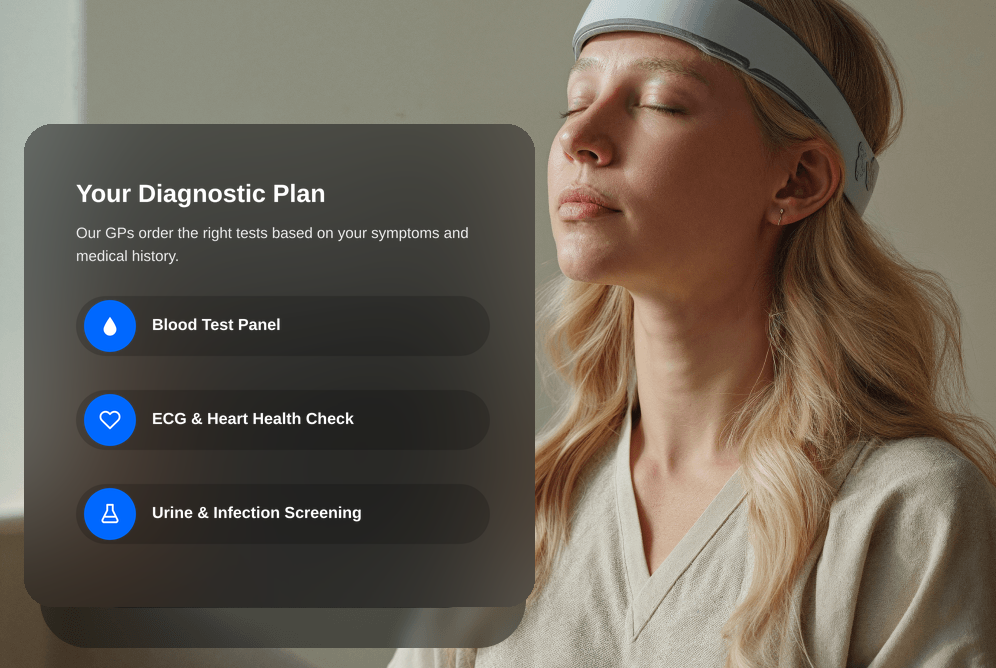
Diagnostic testing plan including blood test panel, ECG and urine screening
03

Tests and referrals, if you need them

Where testing will actually answer the question, we arrange it — blood tests and health screening through our laboratory partner, or a referral for ultrasound, X-ray, CT or MRI through private imaging providers. We will also tell you when a scan is not the right next step.
1–7 days
Personalised results and treatment plan from a private GP consultation
04

Results and next steps

Your GP talks you through what the results mean and agrees the next step with you. Every consultation ends with your treatment plan in writing, and any prescription goes to your own pharmacy.
20 minutes
GP follow-up reminder for ongoing care and progress monitoring
05

Ongoing care and follow-up

Follow-up appointments, progress monitoring and ongoing advice — including saying plainly when something needs in-person or NHS care instead.

Ongoing

How we compare

Time to be seen

Appointment length

Your NHS record in the room

Written treatment plan

Told when a test isn’t needed

Cost

Varies by practice

Typically 10 minutes

Yes, your full record

Not routinely

Usually

Free

Same day

Often 10 to 15 minutes

Usually not

Sometimes charged

Varies by provider

Often a subscription

Questions about our service

How quickly can I be seen?

Same-day access is usually available, from 6am to 10pm, seven days a week. You choose a time that suits you rather than waiting on hold at 8am.

Will I see the same doctor each time?

Yes. Care is led personally by Dr Mohammad Khan, so you are not passed between clinicians. Continuity is the point of a small practice: someone who knows your history and is listening attentively rather than working through a checklist.

Can you see my NHS records?

Yes, with your consent. We can access your Summary Care Record during the consultation, so your current medications, allergies and significant history are in the room. That means fewer questions you have already answered elsewhere, and safer prescribing.

Are you trying to replace my NHS GP?

No. We are not here to replace GPs, only to support them. Your NHS practice remains responsible for your ongoing care, and with your consent we write to them after the consultation. We are useful when you need to be seen sooner, or want more time than a standard appointment allows.

What is included in the appointment?

Twenty unhurried minutes and a comprehensive assessment. A written treatment plan is included, along with any prescription, sick note or referral letter arising from the consultation, at no extra charge.

How much does it cost?

£40 for 20 minutes, self-pay. Membership is optional and never required. Priced for fairness, because we are not here to charge extortionate amounts for access to a doctor.

What does “treatable online” actually mean?

It means the diagnosis can usually be made from your history and photographs, and that treatment can be arranged safely without examining you. Where a condition is not marked treatable online, it is because examination is the diagnosis — listening to a chest, feeling an abdomen, examining an ear or a joint — or because a procedure or device is needed.

Can you prescribe antibiotics?

Yes, where there is a genuine bacterial infection — cellulitis, impetigo, bacterial urine infections, confirmed strep throat. We will also frequently tell you that you do not need one. Most sore throats, coughs, colds and earaches are viral, and an antibiotic gives you the side effects with none of the benefit.

What if the GP cannot help with what I need?

If your problem turns out to be genuinely outside what we can do remotely, the doctor will tell you straight away, point you to the right service, and refund your fee in full. We would rather do that than fill twenty minutes to justify the charge.

What should I do in an emergency?

Call 999 or go to A&E — do not book an online appointment and do not wait for a reply to an email. For urgent problems that are not emergencies, NHS 111 is available 24 hours a day, online or by phone, and can direct you to the right service.

Patient reviews

What our patients say

No reviews published yet.
Ready to see a GP?20 minutes with a GMC-registered doctor. £40, usually same day.
Book a consultation