Home

/

Services

/

Sexual Health Consultation

Sexual Health Consultation

A confidential appointment for sexual health concerns, with screening arranged through an accredited partner where needed.

£40

20 minutes

Test requests and any prescription issued within 10 minutes of your consultation ending

Unhurried care from a GMC-registered GP

6am to 10pm, seven days a week

Prescriptions, sick notes and referral letters included

Your NHS records in the room, with your consent

Clinically reviewed by Dr Mohammad Khan · Last reviewed

August 23, 2026

Book a consultation

A 20-minute appointment with a GMC-registered GP for £40. Same-day appointments are usually available, 6am to 10pm, seven days a week.

Private GP care led personally by Dr Mohammad Zubair Khan, GMC 7563469.

Why patients choose Cheshire Clinics

GMC registered doctors badge - every Cheshire Clinics consultation is with a General Medical Council registered GP

GMC-registered

Care led personally by Dr Khan

Royal College of General Practitioners badge - RCGP trained private GP consultations at Cheshire Clinics

RCGP-trained

Attentive, unhurried care that listens properly

Google five star reviews badge - Cheshire Clinics private GP online

Highly rated by patients

Five-star Google reviews from the people we have looked after

Care Quality Commission registered badge - Cheshire Clinics online GP service is registered with the CQC, England's independent regulator of health and social care

CQC-registered

Registered with the Care Quality Commission

Same-Day Appointments
Sick Notes
Private Prescriptions
Blood Tests
Menopause & HRT
Weight Management
Mental Health
Specialist Referrals
Same-Day Appointments
Sick Notes
Private Prescriptions
Blood Tests
Menopause & HRT
Weight Management
Mental Health
Specialist Referrals

Overview

Sexual health is one of the areas where people most value not sitting in a waiting room. Consultations are private, and kept separate from your NHS record unless you ask otherwise.

What's included

  • A 20-minute confidential consultation
  • STI screening arranged where appropriate, at an accredited clinic
  • Treatment and partner notification advice if anything is found
  • Results discussed with you directly, never by text alone
  • Your treatment plan in writing, sent after every consultation

Confidentiality

Nothing is shared with your NHS GP without your explicit consent. Sexual health care is kept separate from your main record unless you ask otherwise.

How it works

1. Book discreetly

No waiting room, no reception desk, no one you might know sitting opposite you.

2. Timing matters

Most STIs need at least 14 days after exposure to be detectable. A fourth-generation HIV test is conclusive at 45 days after exposure, though it can detect many infections from around ten days. The GP will tell you when to test rather than letting you test too early and be falsely reassured.

3. Screening and treatment

Sample at an accredited clinic, results reviewed with you, treatment arranged if needed.

Ready to book this?

Book a consultation

What to expect

First: is this urgent rather than routine?

If a possible HIV exposure was within the last 72 hours, do not book an appointment. Post-exposure prophylaxis is time-critical and loses effectiveness by the hour. Go to A&E or a sexual health clinic now — both provide it free.

Emergency contraception is also time-sensitive and available free from pharmacies and sexual health clinics, usually the same day.

Expect direct questions, asked without judgement

The questions are specific because the answers change the testing and the treatment: how many partners and over what period, what kind of sex, whether condoms were used, whether partners were male, female or both, and whether anyone has been diagnosed with anything.

None of this is asked out of curiosity, and none of it will be met with surprise. An accurate answer means the right tests; a diplomatic one means the wrong ones.

Timing matters more than people expect

Testing too early gives false reassurance, which is the worst possible outcome. Window periods differ by infection:

  • Chlamydia and gonorrhoea — reliable around two weeks after exposure
  • HIV — a modern fourth-generation test is reliable at 45 days, and a negative before then does not exclude it
  • Syphilis — up to 12 weeks

The GP will tell you when to test rather than testing on the day and calling it clear.

Where to test from matters too

If you have had oral or anal sex, a urine sample alone will miss infections. Throat and rectal swabs are needed, and they are frequently omitted — including by online kits. Self-taken swabs are as accurate as clinician-taken ones, so this is not a reason to be seen in person.

Confidentiality

Nothing is shared with your NHS GP without your explicit consent. Sexual health care is kept separate from your main record unless you ask otherwise.

Who it's for

Book if

  • You have had a new or unprotected partner
  • A partner has been diagnosed with something
  • You have symptoms — discharge, pain, itching, sores or unusual bleeding
  • You want routine screening for peace of mind
  • You are considering PrEP

Please also know

NHS sexual health services are free and genuinely excellent. If that is the better route for you we will say so. What we offer is speed, privacy and an appointment that fits your day — not better clinical care.

If exposure was within the last 72 hours, do not book an appointment. Post-exposure prophylaxis is time-critical and available now from A&E or a sexual health clinic.

After your appointment

Results come to you directly

Discussed with a GP rather than sent as a text saying "normal". If anything is positive you will be told what it means, how it is treated, and what to do about partners — in a conversation, not a message.

Two treatments we cannot give remotely

Gonorrhoea is treated with an intramuscular injection of ceftriaxone, and syphilis with intramuscular penicillin. Neither can be given by video, and the oral alternatives are meaningfully less effective — gonorrhoea in particular has developed substantial resistance.

Where a result points that way, we will arrange a sexual health clinic rather than prescribe something weaker by tablet. That is the right answer even though it means sending you elsewhere.

Telling partners

Uncomfortable and genuinely important — an untreated partner means reinfection, and for chlamydia in particular means avoidable damage to fertility.

NHS sexual health clinics will notify partners anonymously on your behalf. They contact them without naming you. It is free, it is a normal part of what they do, and it removes the hardest part of this entirely. Use it.

Test of cure, and when to have sex again

  • Avoid sex — including oral — for seven days after treatment, and until any partner has been treated too. This is where reinfection happens
  • Gonorrhoea and syphilis need a test of cure. Chlamydia usually does not, unless you are pregnant or symptoms persist
  • Retesting after three months is worth doing if you have had one infection, because the rate of a second is meaningfully higher

Worth considering afterwards

  • PrEP if HIV risk is ongoing — free on the NHS through sexual health clinics, and highly effective
  • Hepatitis B vaccination, free for those at increased risk
  • HPV vaccination, which is worth asking about

What this service cannot do

If exposure was within the last 72 hours, do not book an appointment. Post-exposure prophylaxis for HIV is time-critical and gets less effective by the hour. Go to A&E or a sexual health clinic now — both provide it free.

Some treatments cannot be given remotely, because they are injections. Gonorrhoea is treated with intramuscular ceftriaxone and syphilis with intramuscular penicillin. Where the result points that way, you need a sexual health clinic, and we will arrange it rather than prescribe something less effective by tablet.

NHS sexual health clinics remain the better route for several things: free treatment, free PEP and PrEP, anonymous partner notification, and on-site microscopy that gives an answer the same hour. What we offer is privacy and speed, not superior care, and we will say so where the clinic is the sensible choice.

PrEP is not issued at a first appointment. It requires a baseline HIV test, kidney function and hepatitis B status first, then monitoring every three months. We can start that process; we cannot compress it.

What needs examining: genital ulcers, lumps and testicular swelling. Photographs help, but there is a limit to what any clinician can conclude from one — a testicular lump in particular needs examination and often a scan, and we will refer rather than reassure.

Under-16s are not seen for sexual health remotely. Where a consultation raises concerns about coercion, exploitation or a child at risk, we have safeguarding duties and will act on them.

Common questions

Should I just use an NHS clinic instead?

For several things, yes — and we will say so rather than take your money.

NHS sexual health services are free, genuinely excellent, and better than us at: treatment requiring injections, free PEP and PrEP, anonymous partner notification, and on-site microscopy giving an answer the same hour.

What we offer is privacy, speed and an appointment that fits your day — not superior clinical care. If the clinic is the better route for your situation, that is what we will tell you.

How soon after exposure can I test?

This is the question that matters most, because testing too early gives false reassurance.

  • Chlamydia and gonorrhoea — around two weeks
  • HIV — a fourth-generation test is reliable at 45 days. Earlier negatives do not exclude infection
  • Syphilis — up to 12 weeks

If you test early and it is negative, you will need to repeat it. Better to be told that than to be reassured wrongly.

I had unprotected sex last night. What should I do?

If there is any HIV risk, go to A&E or a sexual health clinic now rather than booking with us. PEP must start within 72 hours and works better the sooner it begins. It is free.

If emergency contraception is needed, that is also time-critical and free from pharmacies and sexual health clinics.

Then test at the right interval for everything else.

Do I need swabs, or is a urine test enough?

Urine alone is not enough if you have had oral or anal sex — and this is one of the commonest gaps in testing, including with postal kits.

Chlamydia and gonorrhoea live perfectly happily in the throat and rectum with no symptoms at all, and a urine test will not find them. Self-taken throat and rectal swabs are as accurate as clinician-taken ones.

Will this go on my medical record?

Not without your explicit consent. Sexual health information is treated with additional confidentiality, and nothing is shared with your NHS GP unless you ask us to.

The same applies at NHS sexual health clinics, which operate separately from GP records by design.

Can I get PrEP?

Not at a first appointment, and no responsible service would offer it that way. PrEP requires a baseline HIV test, kidney function and hepatitis B status first, then monitoring every three months.

We can start that process — but worth knowing that PrEP is free on the NHS through sexual health clinics, along with the monitoring, and for most people that is the better route.

I have a lump or an ulcer. Can you look at it?

Photographs help and we look at them routinely. But there is a limit to what any clinician can conclude from an image, and some things need examining.

A testicular lump in particular needs in-person assessment and usually a scan — we will refer rather than reassure. Genital ulcers usually need swabbing, which means being seen.

My partner has been diagnosed with something.

Get tested, and ask whether you should be treated without waiting for your result — for some infections that is standard, because treating both partners simultaneously is what prevents the cycle of reinfection.

Bring what you know: which infection, when they were treated, and whether you have had sex since.

Dr Mohammad Zubair Khan, GMC-registered private GP and founder of Cheshire Clinics

Clinically reviewed by Dr Mohammad Zubair Khan, GMC 7563469

Last reviewed

August 23, 2026

How it works

What happens when you book

£40 for a 20-minute appointment with a GMC-registered GP, 6am to 10pm, seven days a week. Membership is optional and never required.
Cheshire Clinics online GP appointment booking confirmation on mobile
01

Book your appointment

Pick a time that suits you — 6am to 10pm, seven days a week, including weekends and bank holidays. £40 for 20 minutes, self-pay, with no insurance to arrange.
5–10 minutes
Online video consultation with a GMC-registered private GP
02

Meet your GP

A 20-minute video or phone consultation with a GMC-registered GP — long enough for a proper conversation about your symptoms, your history and what matters to you.
20 minutes
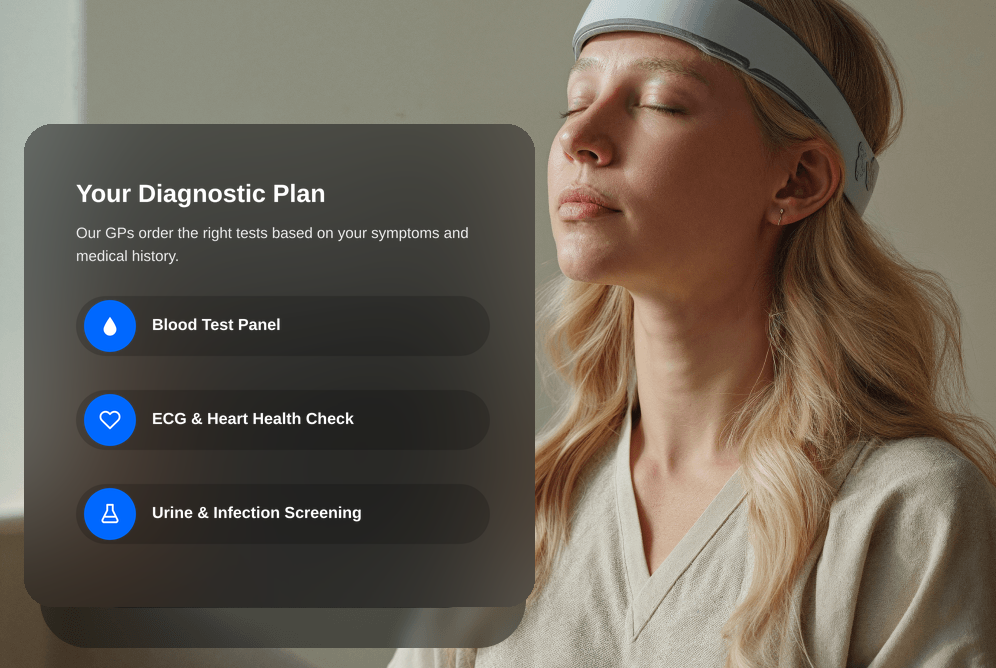
Diagnostic testing plan including blood test panel, ECG and urine screening
03

Tests and referrals, if you need them

Where testing will actually answer the question, we arrange it — blood tests and health screening through our laboratory partner, or a referral for ultrasound, X-ray, CT or MRI through private imaging providers. We will also tell you when a scan is not the right next step.
1–7 days
Personalised results and treatment plan from a private GP consultation
04

Results and next steps

Your GP talks you through what the results mean and agrees the next step with you. Every consultation ends with your treatment plan in writing, and any prescription goes to your own pharmacy.
20 minutes
GP follow-up reminder for ongoing care and progress monitoring
05

Ongoing care and follow-up

Follow-up appointments, progress monitoring and ongoing advice — including saying plainly when something needs in-person or NHS care instead.

Ongoing

How we compare

Time to be seen

Appointment length

Your NHS record in the room

Written treatment plan

Told when a test isn’t needed

Cost

Varies by practice

Typically 10 minutes

Yes, your full record

Not routinely

Usually

Free

Same day

Often 10 to 15 minutes

Usually not

Sometimes charged

Varies by provider

Often a subscription

Questions about our service

How quickly can I be seen?

Same-day access is usually available, from 6am to 10pm, seven days a week. You choose a time that suits you rather than waiting on hold at 8am.

Will I see the same doctor each time?

Yes. Care is led personally by Dr Mohammad Khan, so you are not passed between clinicians. Continuity is the point of a small practice: someone who knows your history and is listening attentively rather than working through a checklist.

Can you see my NHS records?

Yes, with your consent. We can access your Summary Care Record during the consultation, so your current medications, allergies and significant history are in the room. That means fewer questions you have already answered elsewhere, and safer prescribing.

Are you trying to replace my NHS GP?

No. We are not here to replace GPs, only to support them. Your NHS practice remains responsible for your ongoing care, and with your consent we write to them after the consultation. We are useful when you need to be seen sooner, or want more time than a standard appointment allows.

What is included in the appointment?

Twenty unhurried minutes and a comprehensive assessment. A written treatment plan is included, along with any prescription, sick note or referral letter arising from the consultation, at no extra charge.

How much does it cost?

£40 for 20 minutes, self-pay. Membership is optional and never required. Priced for fairness, because we are not here to charge extortionate amounts for access to a doctor.

What does “treatable online” actually mean?

It means the diagnosis can usually be made from your history and photographs, and that treatment can be arranged safely without examining you. Where a condition is not marked treatable online, it is because examination is the diagnosis — listening to a chest, feeling an abdomen, examining an ear or a joint — or because a procedure or device is needed.

Can you prescribe antibiotics?

Yes, where there is a genuine bacterial infection — cellulitis, impetigo, bacterial urine infections, confirmed strep throat. We will also frequently tell you that you do not need one. Most sore throats, coughs, colds and earaches are viral, and an antibiotic gives you the side effects with none of the benefit.

What if the GP cannot help with what I need?

If your problem turns out to be genuinely outside what we can do remotely, the doctor will tell you straight away, point you to the right service, and refund your fee in full. We would rather do that than fill twenty minutes to justify the charge.

What should I do in an emergency?

Call 999 or go to A&E — do not book an online appointment and do not wait for a reply to an email. For urgent problems that are not emergencies, NHS 111 is available 24 hours a day, online or by phone, and can direct you to the right service.

Patient reviews

What our patients say

No reviews published yet.
Ready to see a GP?20 minutes with a GMC-registered doctor. £40, usually same day.
Book a consultation