Home

/

Tests & scans

/

Ultrasound Scan Referral

Ultrasound Scan Referral

A referral for private ultrasound — no radiation, quick, and often the right first-line scan.

£40 consultation; scan priced by the imaging provider

Report timescale confirmed by the imaging provider when you book

Ultrasound scan

Referred by a GMC-registered GP, results reviewed by the same doctor

Taken at a partner site near you

Results explained in plain English, not just a number

Your NHS records in the room, with your consent

Clinically reviewed by Dr Mohammad Khan · Last reviewed

August 23, 2026

Book a consultation

A 20-minute appointment with a GMC-registered GP for £40. Same-day appointments are usually available, 6am to 10pm, seven days a week.

Private GP care led personally by Dr Mohammad Zubair Khan, GMC 7563469.

Why patients choose Cheshire Clinics

GMC registered doctors badge - every Cheshire Clinics consultation is with a General Medical Council registered GP

GMC-registered

Care led personally by Dr Khan

Royal College of General Practitioners badge - RCGP trained private GP consultations at Cheshire Clinics

RCGP-trained

Attentive, unhurried care that listens properly

Google five star reviews badge - Cheshire Clinics private GP online

Highly rated by patients

Five-star Google reviews from the people we have looked after

Care Quality Commission registered badge - Cheshire Clinics online GP service is registered with the CQC, England's independent regulator of health and social care

CQC-registered

Registered with the Care Quality Commission

Same-Day Appointments
Sick Notes
Private Prescriptions
Blood Tests
Menopause & HRT
Weight Management
Mental Health
Specialist Referrals
Same-Day Appointments
Sick Notes
Private Prescriptions
Blood Tests
Menopause & HRT
Weight Management
Mental Health
Specialist Referrals

Overview

Ultrasound is quick, involves no radiation, and is frequently the correct first investigation rather than a lesser alternative to MRI.

It is the standard test for gallstones, kidney and liver assessment, thyroid and testicular lumps, and gynaecological concerns.

What this test measures

Real-time images using sound waves. Abdominal, pelvic, thyroid, testicular, breast, soft tissue and vascular scans are all available.

Why you might need it

Commonly requested for

  • Abdominal pain, particularly upper right — gallstones
  • Abnormal liver or kidney blood results
  • A lump you can feel, anywhere
  • Pelvic pain, heavy periods or suspected fibroids
  • Testicular lumps or swelling
  • Thyroid nodules

Why ultrasound is often the right first choice

It is quick, involves no radiation, needs no injection, and for several questions — gallstones, ovarian cysts, testicular lumps — it is genuinely the best test rather than a cheaper alternative to MRI.

It is also real-time, which means the sonographer can press on the area that hurts and watch what happens.

What's included

  • A 20-minute consultation to confirm ultrasound is the right test
  • A referral letter with the clinical question stated
  • Booking through Vista Health or a provider of your choosing
  • A results review with a GP once reported

Types available

  • Abdominal — liver, gallbladder, kidneys, pancreas, spleen
  • Pelvic and transvaginal — uterus, ovaries
  • Testicular
  • Thyroid and neck
  • Breast
  • Soft tissue and musculoskeletal
  • Vascular, including Doppler studies

Ready to arrange this test?

Book a consultation

How the referral works

Partner site:

Vista Health

Consultation, referral issued to Vista Health, you book your appointment, and the radiologist's report is reviewed with you afterwards.

Preparation required

Abdominal scans usually require fasting for six hours. Pelvic scans usually require a full bladder — drink a litre of water an hour beforehand and do not empty it.

Preparation varies by scan type and the provider will confirm exactly what is needed.

Understanding your results

Ultrasound is the most operator-dependent scan there is

The quality of the answer depends heavily on who holds the probe. Unlike MRI or CT, which produce the same images regardless, ultrasound is a live examination performed by a person.

That is why the clinical question on the referral matters so much — a sonographer told what to look for looks for it.

Common findings that sound worse than they are

  • Gallstones — found in a large proportion of adults, most of whom never have symptoms. They only matter if they are causing pain
  • Simple ovarian cysts — part of a normal cycle, and usually resolve on their own
  • Fatty liver — extremely common, and improves substantially with around 7 to 10 per cent weight loss
  • Simple kidney cysts — increasingly common with age and almost always harmless
  • Fibroids — very common, and only significant if they cause symptoms

Each of these routinely causes alarm on a report and turns out to need nothing at all.

Where the preparation determines the answer

An abdominal scan needs a 6-hour fast, because a contracted gallbladder full of food hides stones. A pelvic scan needs a full bladder — usually a litre of water an hour beforehand — because it pushes the bowel out of the way.

Getting this wrong means the scan is repeated, which is the commonest avoidable waste on this page.

What a normal scan means

That the structures examined look normal on the day. Ultrasound cannot see everything — bowel gas and body habitus both limit it — so a normal result narrows the field without closing it.

What this test cannot tell you

What ultrasound cannot see well

  • Anything behind bone or gas. Sound does not pass through either, which is why lungs, brain and much of the bowel are effectively invisible
  • The pancreas, often — overlying bowel gas obscures it in a substantial proportion of people
  • Deep structures in larger patients, where image quality falls off
  • Bone detail — that is X-ray or CT

The operator problem

A structure that was not examined cannot be reported on. Ultrasound reports describe what was looked at, and the scope is set by the referral.

A scan done to answer one question does not incidentally exclude everything else.

What it cannot tell you

Whether something is cancerous. Ultrasound can raise or lower suspicion; only a biopsy establishes it.

And it cannot explain pain that has no structural cause — which describes a good deal of abdominal and pelvic pain, including IBS.

What we cannot do

We do not perform scans — we refer. And acute severe abdominal pain needs assessment today, in person, not a scan appointment next week.

Costs explained

What you pay

  • £40 for the consultation
  • The scan, quoted by the imaging provider — ultrasound is generally the cheapest imaging available, which is one of its advantages
  • £40 for the results review

The free route

NHS ultrasound is free where indicated, and waits are frequently shorter than for MRI or CT because the equipment is more widely available.

Ask before assuming a long wait. Right to Choose also lets you select a different NHS provider at no cost.

All pregnancy scans are free on the NHS, and NHS scans are the ones integrated with your maternity care. Private "reassurance" and gender scans are not medical scans and do not replace them.

Where paying makes sense

A long local wait for a non-urgent question — gallstones, a lump, a persistent symptom — where knowing sooner changes what happens next.

Where not to spend money

  • Whole-body "screening" ultrasound with no symptoms. It generates incidental findings at a high rate and finds very little that matters
  • Repeat scans of a finding already established as benign, unless someone has asked for monitoring
  • Attending without the right preparation — you will pay twice

Common questions

Do I need to prepare?

It depends entirely on the region, and getting it wrong means repeating the scan.

Abdominal scan: nothing to eat for 6 hours beforehand, because a gallbladder full of food contracts and hides stones.

Pelvic scan: a full bladder — usually about a litre of water an hour before, and do not empty it. Uncomfortable, but it is what makes the pelvis visible.

Most other scans need no preparation at all.

Is ultrasound safe?

Yes — no radiation, and it is safe in pregnancy. That is why it is the first-line scan for so many questions.

Does it hurt?

No. Cold gel and firm pressure with the probe, which can be uncomfortable over a tender area but is not painful.

What is a transvaginal scan and can I decline it?

An internal probe giving much better views of the uterus and ovaries than a scan through the abdomen.

You can absolutely decline it, and you can ask for a chaperone — that is your right, and any unit will arrange it. An external scan will be done instead, with the caveat that the views are less detailed.

They found gallstones. Do I need surgery?

Not automatically. Gallstones are found in a large proportion of adults and most never cause a problem.

They are treated when they cause symptoms — pain after fatty meals, or complications. Stones found incidentally on a scan for something else are usually left alone.

They found an ovarian cyst. Is that serious?

Usually not at all. Simple cysts are part of a normal menstrual cycle and most resolve without any treatment.

Size, appearance and whether you are past menopause are what determine whether anything needs doing. Most need only a repeat scan, or nothing.

Can ultrasound tell if something is cancer?

No — it can raise or lower suspicion, but only a biopsy establishes it.

Certain appearances are reassuring and others prompt further investigation, and that is what the report is describing.

Can you scan my whole body?

Not usefully, and we would not arrange it.

Whole-body screening ultrasound in someone with no symptoms produces incidental findings at a high rate and very rarely finds anything important. Each finding then needs chasing.

Is a private pregnancy scan the same as an NHS one?

No. NHS pregnancy scans are free, and they are the ones connected to your maternity care.

Private reassurance and gender scans are not medical scans and do not replace the NHS ones — which is worth being clear about before paying for either.

Dr Mohammad Zubair Khan, GMC-registered private GP and founder of Cheshire Clinics

Clinically reviewed by Dr Mohammad Zubair Khan, GMC 7563469

Last reviewed

August 23, 2026

How it works

What happens when you book

£40 for a 20-minute appointment with a GMC-registered GP, 6am to 10pm, seven days a week. Membership is optional and never required.
Cheshire Clinics online GP appointment booking confirmation on mobile
01

Book your appointment

Pick a time that suits you — 6am to 10pm, seven days a week, including weekends and bank holidays. £40 for 20 minutes, self-pay, with no insurance to arrange.
5–10 minutes
Online video consultation with a GMC-registered private GP
02

Meet your GP

A 20-minute video or phone consultation with a GMC-registered GP — long enough for a proper conversation about your symptoms, your history and what matters to you.
20 minutes
Diagnostic testing plan including blood test panel, ECG and urine screening
03

Tests and referrals, if you need them

Where testing will actually answer the question, we arrange it — blood tests and health screening through our laboratory partner, or a referral for ultrasound, X-ray, CT or MRI through private imaging providers. We will also tell you when a scan is not the right next step.
1–7 days
Personalised results and treatment plan from a private GP consultation
04

Results and next steps

Your GP talks you through what the results mean and agrees the next step with you. Every consultation ends with your treatment plan in writing, and any prescription goes to your own pharmacy.
20 minutes
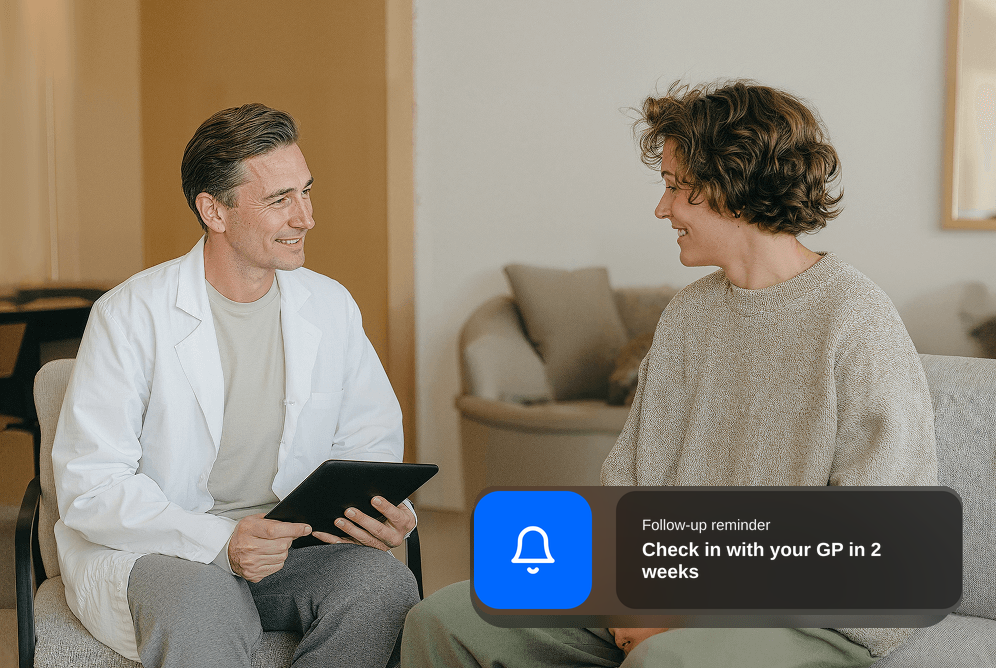
GP follow-up reminder for ongoing care and progress monitoring
05

Ongoing care and follow-up

Follow-up appointments, progress monitoring and ongoing advice — including saying plainly when something needs in-person or NHS care instead.

Ongoing

How we compare

Time to be seen

Appointment length

Your NHS record in the room

Written treatment plan

Told when a test isn’t needed

Cost

Varies by practice

Typically 10 minutes

Yes, your full record

Not routinely

Usually

Free

Same day

Often 10 to 15 minutes

Usually not

Sometimes charged

Varies by provider

Often a subscription

Questions about our service

How quickly can I be seen?

Same-day access is usually available, from 6am to 10pm, seven days a week. You choose a time that suits you rather than waiting on hold at 8am.

Will I see the same doctor each time?

Yes. Care is led personally by Dr Mohammad Khan, so you are not passed between clinicians. Continuity is the point of a small practice: someone who knows your history and is listening attentively rather than working through a checklist.

Can you see my NHS records?

Yes, with your consent. We can access your Summary Care Record during the consultation, so your current medications, allergies and significant history are in the room. That means fewer questions you have already answered elsewhere, and safer prescribing.

Are you trying to replace my NHS GP?

No. We are not here to replace GPs, only to support them. Your NHS practice remains responsible for your ongoing care, and with your consent we write to them after the consultation. We are useful when you need to be seen sooner, or want more time than a standard appointment allows.

What is included in the appointment?

Twenty unhurried minutes and a comprehensive assessment. A written treatment plan is included, along with any prescription, sick note or referral letter arising from the consultation, at no extra charge.

How much does it cost?

£40 for 20 minutes, self-pay. Membership is optional and never required. Priced for fairness, because we are not here to charge extortionate amounts for access to a doctor.

What does “treatable online” actually mean?

It means the diagnosis can usually be made from your history and photographs, and that treatment can be arranged safely without examining you. Where a condition is not marked treatable online, it is because examination is the diagnosis — listening to a chest, feeling an abdomen, examining an ear or a joint — or because a procedure or device is needed.

Can you prescribe antibiotics?

Yes, where there is a genuine bacterial infection — cellulitis, impetigo, bacterial urine infections, confirmed strep throat. We will also frequently tell you that you do not need one. Most sore throats, coughs, colds and earaches are viral, and an antibiotic gives you the side effects with none of the benefit.

What if the GP cannot help with what I need?

If your problem turns out to be genuinely outside what we can do remotely, the doctor will tell you straight away, point you to the right service, and refund your fee in full. We would rather do that than fill twenty minutes to justify the charge.

What should I do in an emergency?

Call 999 or go to A&E — do not book an online appointment and do not wait for a reply to an email. For urgent problems that are not emergencies, NHS 111 is available 24 hours a day, online or by phone, and can direct you to the right service.

Patient reviews

What our patients say

No reviews published yet.
Ready to see a GP?20 minutes with a GMC-registered doctor. £40, usually same day.
Book a consultation