Is severe period pain normal?
No — and this is the most consequential misconception on the page. Some cramping in the first day or two is normal. Pain that regularly stops you going to work or school, that over-the-counter painkillers do not touch, or that has been getting worse over the years, is a symptom and deserves investigation.
A very large number of women are told for years that pain like this is simply their lot. It is one of the main reasons conditions like endometriosis and adenomyosis go undiagnosed for so long.
How do I get endometriosis taken seriously?
Bring evidence rather than an impression. Three things move the conversation:
- A pain diary covering two or three cycles, showing the relationship to your period and, crucially, the days you lost
- Name the specific symptoms: pain on deep penetration during sex; pain opening bowels or passing urine that is worse around your period; pain that starts days before bleeding does; painkillers that do not work
- Ask directly for a gynaecology referral, and ask for the reasoning to be recorded if it is declined
Average time from first symptom to diagnosis in the UK is measured in years, not months. Being specific and persistent genuinely shortens it.
My scan was normal. Does that rule out endometriosis?
No — and this matters enormously. A normal pelvic ultrasound does not exclude endometriosis. Ultrasound reliably detects endometriomas — cysts on the ovaries — and can suggest deep disease in expert hands, but superficial peritoneal endometriosis, which is the commonest form, is usually invisible on a scan.
The definitive diagnosis is laparoscopy — keyhole surgery to look directly, with the option of treating what is found in the same operation. "Your scan was clear so it isn't endometriosis" is a widespread and incorrect piece of reassurance, and it costs people years.
Sudden severe pain on one side — how urgent?
A&E, now. The two things being excluded are ovarian torsion — where the ovary twists on its blood supply, causing severe one-sided pain with vomiting, and which needs surgery within hours if the ovary is to be saved — and a ruptured ovarian cyst, which can bleed significantly.
And in anyone who could be pregnant, an ectopic pregnancy. Do a test; a positive one with one-sided pain is an emergency.
What is pelvic inflammatory disease, and why the urgency?
Infection spreading upward from the cervix into the womb, tubes and ovaries — usually from chlamydia or gonorrhoea, though often no organism is identified. It causes deep pelvic pain, abnormal discharge, pain during sex, sometimes fever and irregular bleeding.
It is urgent because each episode raises the risk of tubal damage, infertility and ectopic pregnancy, and that risk climbs with every week of delay. Treatment is a course of antibiotics, started on suspicion rather than waiting for swab results, with partner treatment alongside.
Could it be my bowel or bladder rather than gynaecological?
Frequently, and the overlap is genuine. IBS and endometriosis are commonly confused, because both cause pain, bloating and altered bowels — and many women with endometriosis carry an IBS label for years first.
The distinguishing feature is the cycle. If symptoms are consistently worse around your period, that points gynaecological regardless of what label you already have. Bladder pain syndrome — pain that worsens as the bladder fills and eases on emptying, with repeatedly negative urine cultures — is another commonly missed cause.
Do men get pelvic pain?
Yes, and it is markedly under-discussed. Chronic prostatitis and chronic pelvic pain syndrome cause pain in the perineum, testicles, tip of the penis or lower abdomen, often with urinary symptoms and pain on ejaculation. It is common, frequently treated as recurrent infection with repeated antibiotic courses, and often has a substantial muscular and pelvic floor component that responds to specialist physiotherapy.
Sudden severe testicular pain is a different matter entirely — that is torsion, and it is an emergency.
What can be sorted out remotely?
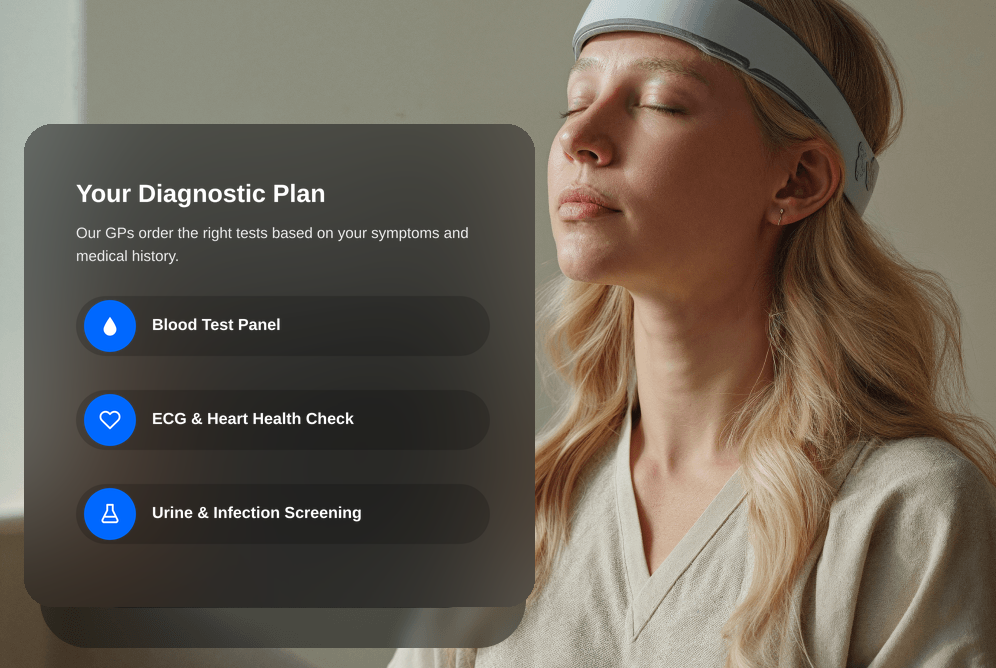
A good deal. The history does most of the diagnostic work in pelvic pain, and a proper 20 minutes to take it is often more than people get elsewhere. We can arrange pelvic ultrasound, blood tests and STI screening, prescribe effective pain relief and hormonal treatment, and write a detailed gynaecology referral setting out the pattern — which is frequently what has been missing.
What we cannot do is examine you, and for suspected pelvic infection, an unexplained mass, or acute severe pain, examination is what decides it. We will say so rather than working around it.