Home

/

Tests & scans

/

Full Blood Count (FBC)

Full Blood Count (FBC)

The foundation blood test — red cells, white cells and platelets, reviewed properly rather than skimmed.

Quoted after consultation

Results usually next working day

Blood sample

Referred by a GMC-registered GP, results reviewed by the same doctor

Taken at a partner site near you

Results explained in plain English, not just a number

Your NHS records in the room, with your consent

Clinically reviewed by Dr Mohammad Khan · Last reviewed

August 23, 2026

Book a consultation

A 20-minute appointment with a GMC-registered GP for £40. Same-day appointments are usually available, 6am to 10pm, seven days a week.

Private GP care led personally by Dr Mohammad Zubair Khan, GMC 7563469.

Why patients choose Cheshire Clinics

GMC registered doctors badge - every Cheshire Clinics consultation is with a General Medical Council registered GP

GMC-registered

Care led personally by Dr Khan

Royal College of General Practitioners badge - RCGP trained private GP consultations at Cheshire Clinics

RCGP-trained

Attentive, unhurried care that listens properly

Google five star reviews badge - Cheshire Clinics private GP online

Highly rated by patients

Five-star Google reviews from the people we have looked after

Care Quality Commission registered badge - Cheshire Clinics online GP service is registered with the CQC, England's independent regulator of health and social care

CQC-registered

Registered with the Care Quality Commission

Same-Day Appointments
Sick Notes
Private Prescriptions
Blood Tests
Menopause & HRT
Weight Management
Mental Health
Specialist Referrals
Same-Day Appointments
Sick Notes
Private Prescriptions
Blood Tests
Menopause & HRT
Weight Management
Mental Health
Specialist Referrals

Overview

The full blood count is the starting point for almost any investigation. It counts and characterises the three cell types circulating in your blood — red cells, white cells and platelets — and in doing so screens for anaemia, infection, inflammation and clotting problems from a single sample.

It is the most commonly requested blood test in the UK, and also one of the most commonly under-read. A result reported as normal may still contain a pattern worth acting on, because the individual indices carry information that the headline haemoglobin does not.

What this test measures

Haemoglobin — the oxygen-carrying protein. Low haemoglobin is anaemia; the cause is what matters and the other indices point towards it.

Mean cell volume (MCV) — the average size of your red cells, and the single most useful clue to the cause of anaemia. Small cells suggest iron deficiency or thalassaemia trait. Large cells suggest B12 or folate deficiency, an underactive thyroid, alcohol or liver disease. Two people can have identical haemoglobin and entirely different problems.

White cell count with differential — neutrophils, lymphocytes, monocytes, eosinophils and basophils counted separately. The pattern is informative: neutrophils rise with bacterial infection, lymphocytes with viral, and raised eosinophils suggest allergy, asthma or, occasionally, parasitic infection.

Platelets — involved in clotting. Low platelets can cause bruising and bleeding; raised platelets often simply reflect inflammation or iron deficiency.

Haematocrit, MCH and MCHC — supporting measures of red cell concentration and haemoglobin content.

Why you might need it

  • Fatigue — the commonest reason, and anaemia is one of the more readily correctable causes
  • Breathlessness on exertion, or unusual paleness
  • Recurrent or unusually severe infections
  • Unexplained bruising, bleeding gums, or nosebleeds
  • Heavy periods, which are the leading cause of iron deficiency in menstruating women
  • Before starting certain medications, or monitoring during them
  • As the baseline component of a wider health check

An important limitation to state plainly: a normal full blood count does not exclude iron deficiency. Iron stores fall long before haemoglobin does, so someone can be genuinely iron deficient — with the fatigue, hair shedding and restless legs that go with it — while their FBC looks entirely normal. That is why we usually request ferritin alongside it rather than instead of it.

What's included

Included: haemoglobin · haematocrit · mean cell haemoglobin · mean cell haemoglobin concentration · mean cell volume · red blood cell count · white blood cell count with full differential (neutrophils, lymphocytes, monocytes, eosinophils, basophils) · platelet count.

Ready to arrange this test?

Book a consultation

How the referral works

Partner site:

Randox Health

1. Consultation. We establish what we are actually looking for. A full blood count requested without a question in mind produces a number rather than an answer.

2. Referral. You receive a referral to a Randox Health clinic. You choose the location and time.

3. The sample. A single blood draw. No fasting needed.

4. Results review. A GMC-registered GP goes through the result against your symptoms, not just against the reference range — including the indices that a brief report tends to skip over. Where something needs following up, we arrange it.

Preparation required

No fasting required. Recent infection, exercise and dehydration can all affect results.

Understanding your results

The three lines, and what each one means

Red cells and haemoglobin — how well oxygen is carried. Low means anaemia, and the mean cell volume tells you what kind: small cells point to iron deficiency, large cells to B12 or folate deficiency, alcohol or thyroid disease.

White cells — the immune response. A raised count usually means infection or inflammation; the differential says which type of cell is raised, which narrows it considerably.

Platelets — clotting. Low raises bleeding risk; high is most often reactive to inflammation, iron deficiency or recent infection rather than anything sinister.

The normal-count trap

A normal full blood count does not exclude iron deficiency. Stores empty long before haemoglobin falls — so someone can be substantially deficient, with the fatigue and hair shedding that involves, and have a completely normal FBC.

"Your blood count was fine" is not the same as "your iron was checked". Ferritin is a separate test.

Mild abnormalities are extremely common

Around one healthy person in twenty falls outside a reference range on any given marker, purely by definition. A count measures ten or more markers, so a flagged value on a well person is close to expected.

What matters is the size of the abnormality, whether it is new, and the trend. A slightly low white count that has been the same for five years is different from the same value appearing for the first time.

Things that shift the numbers temporarily

Recent infection, strenuous exercise, dehydration, smoking, pregnancy and steroids all move these values around. Repeating an isolated mild abnormality after a few weeks is often more informative than acting on it.

What this test cannot tell you

What a full blood count cannot tell you

  • Whether you have cancer. This is the misunderstanding worth correcting directly. A normal blood count does not exclude cancer — most solid tumours do not affect it at all, particularly early on
  • Whether you are iron deficient. Ferritin is a separate test, and stores empty before the count changes
  • Whether you have an infection now. Viral illnesses frequently leave the count entirely normal
  • Whether inflammation is present. That needs CRP and ESR

What abnormal results usually mean

Overwhelmingly, something benign. Mild abnormalities are common, frequently transient, and usually explained by a recent illness or by normal variation.

Where a result is markedly abnormal, or persistently so, that warrants proper assessment — and occasionally urgent haematology referral. That is a small minority, and we will be clear which situation you are in rather than leaving you to guess.

Where this test is not the right one

If the question is "am I tired because of my iron", ask for ferritin. If it is "is there inflammation", ask for CRP. A full blood count on its own answers fewer questions than people expect, which is why it is usually requested alongside others.

Costs explained

What you pay

  • £40 for the consultation
  • The test, quoted before it is arranged — and a full blood count is among the cheapest available
  • £40 for the results review

It is rarely worth ordering alone

A full blood count in isolation answers fewer questions than most people assume. Where the reason for testing is fatigue, it is worth pairing with ferritin, thyroid function, B12 and inflammatory markers — which is what the fatigue panel does, and usually costs less than requesting them one at a time.

Free NHS route

A full blood count is free on the NHS with any relevant symptom, and it is one of the most commonly requested tests in general practice. If you are registered and have symptoms, that route costs nothing.

Where the fee earns its place

Speed, and the interpretation. Being told what a mildly abnormal value means — and specifically whether it needs repeating, ignoring or acting on — is worth more than the number itself, and it is the part most often missing.

Where not to spend money

Repeating a mild abnormality every few weeks out of anxiety. And buying a full blood count as reassurance about cancer — it does not do that, and believing it does is actively harmful.

Common questions

Will this tell me if I have cancer?

No — and this is the most important thing on the page. A normal full blood count does not exclude cancer. Most solid tumours do not affect it, particularly at an early stage.

It can show changes in blood cancers such as leukaemia, but even there a normal count does not rule them out.

If you have symptoms that worry you, those symptoms need assessing — a reassuring blood count is not the answer.

My result was flagged. Should I be worried?

Usually not. One healthy person in twenty falls outside a reference range on any given marker, and a count measures ten or more.

What matters is how far outside, whether it is new, and the trend. Most mild abnormalities are transient and explained by a recent illness.

Can I be anaemic with a normal count?

You can be iron deficient with a normal count — which is not quite the same thing and matters more.

Stores empty before haemoglobin falls. Ferritin is a separate test, and "your blood count was fine" does not mean it was done.

What does a high white cell count mean?

Most often infection or inflammation, and frequently something that has already passed. Strenuous exercise, stress, smoking and steroids all raise it too.

The differential is what narrows it — raised neutrophils suggest bacterial infection, raised lymphocytes viral, raised eosinophils allergy or parasites.

What about a low white cell count?

Often normal variation, and it is genuinely commoner in people of African and Middle Eastern heritage — a recognised benign pattern that is sometimes mistaken for a problem.

Otherwise it follows viral illness, some medicines, and occasionally autoimmune conditions. Persistently low counts warrant assessment; a one-off mildly low count usually warrants repeating.

My platelets are high. Is that a clot risk?

Usually not. Most raised platelet counts are reactive — to inflammation, infection, iron deficiency or recent surgery — rather than a primary problem.

Persistently high counts need investigating, and iron deficiency is a common and easily missed explanation.

Do I need to fast?

No. But recent infection, heavy exercise and dehydration all affect results — so if you have been unwell, waiting a couple of weeks gives a more useful picture.

Should I repeat an abnormal result?

Frequently yes, and that is a legitimate answer rather than a fobbing-off. An isolated mild abnormality repeated after a few weeks resolves most of these questions without further investigation.

Marked or persistent abnormalities are different, and we will say so clearly.

Is this the same as the test my GP does?

Yes — the full blood count is the full blood count. What differs is the speed and the time spent explaining it.

If you are registered with a GP and have symptoms, the NHS test is free, and we would say so.

Dr Mohammad Zubair Khan, GMC-registered private GP and founder of Cheshire Clinics

Clinically reviewed by Dr Mohammad Zubair Khan, GMC 7563469

Last reviewed

August 23, 2026

How it works

What happens when you book

£40 for a 20-minute appointment with a GMC-registered GP, 6am to 10pm, seven days a week. Membership is optional and never required.
Cheshire Clinics online GP appointment booking confirmation on mobile
01

Book your appointment

Pick a time that suits you — 6am to 10pm, seven days a week, including weekends and bank holidays. £40 for 20 minutes, self-pay, with no insurance to arrange.
5–10 minutes
Online video consultation with a GMC-registered private GP
02

Meet your GP

A 20-minute video or phone consultation with a GMC-registered GP — long enough for a proper conversation about your symptoms, your history and what matters to you.
20 minutes
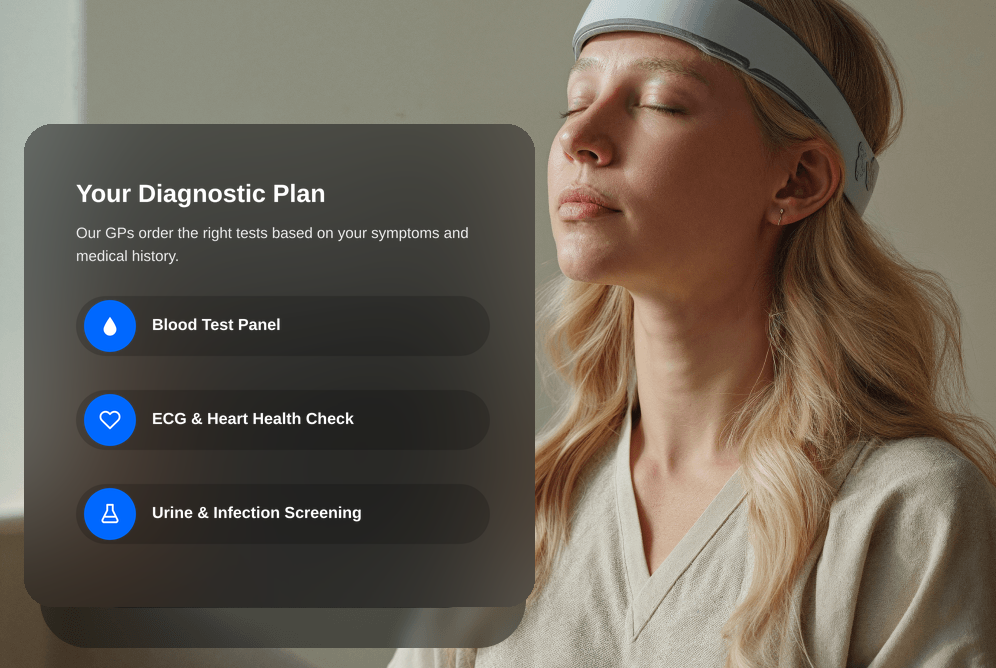
Diagnostic testing plan including blood test panel, ECG and urine screening
03

Tests and referrals, if you need them

Where testing will actually answer the question, we arrange it — blood tests and health screening through our laboratory partner, or a referral for ultrasound, X-ray, CT or MRI through private imaging providers. We will also tell you when a scan is not the right next step.
1–7 days
Personalised results and treatment plan from a private GP consultation
04

Results and next steps

Your GP talks you through what the results mean and agrees the next step with you. Every consultation ends with your treatment plan in writing, and any prescription goes to your own pharmacy.
20 minutes
GP follow-up reminder for ongoing care and progress monitoring
05

Ongoing care and follow-up

Follow-up appointments, progress monitoring and ongoing advice — including saying plainly when something needs in-person or NHS care instead.

Ongoing

How we compare

Time to be seen

Appointment length

Your NHS record in the room

Written treatment plan

Told when a test isn’t needed

Cost

Varies by practice

Typically 10 minutes

Yes, your full record

Not routinely

Usually

Free

Same day

Often 10 to 15 minutes

Usually not

Sometimes charged

Varies by provider

Often a subscription

Questions about our service

How quickly can I be seen?

Same-day access is usually available, from 6am to 10pm, seven days a week. You choose a time that suits you rather than waiting on hold at 8am.

Will I see the same doctor each time?

Yes. Care is led personally by Dr Mohammad Khan, so you are not passed between clinicians. Continuity is the point of a small practice: someone who knows your history and is listening attentively rather than working through a checklist.

Can you see my NHS records?

Yes, with your consent. We can access your Summary Care Record during the consultation, so your current medications, allergies and significant history are in the room. That means fewer questions you have already answered elsewhere, and safer prescribing.

Are you trying to replace my NHS GP?

No. We are not here to replace GPs, only to support them. Your NHS practice remains responsible for your ongoing care, and with your consent we write to them after the consultation. We are useful when you need to be seen sooner, or want more time than a standard appointment allows.

What is included in the appointment?

Twenty unhurried minutes and a comprehensive assessment. A written treatment plan is included, along with any prescription, sick note or referral letter arising from the consultation, at no extra charge.

How much does it cost?

£40 for 20 minutes, self-pay. Membership is optional and never required. Priced for fairness, because we are not here to charge extortionate amounts for access to a doctor.

What does “treatable online” actually mean?

It means the diagnosis can usually be made from your history and photographs, and that treatment can be arranged safely without examining you. Where a condition is not marked treatable online, it is because examination is the diagnosis — listening to a chest, feeling an abdomen, examining an ear or a joint — or because a procedure or device is needed.

Can you prescribe antibiotics?

Yes, where there is a genuine bacterial infection — cellulitis, impetigo, bacterial urine infections, confirmed strep throat. We will also frequently tell you that you do not need one. Most sore throats, coughs, colds and earaches are viral, and an antibiotic gives you the side effects with none of the benefit.

What if the GP cannot help with what I need?

If your problem turns out to be genuinely outside what we can do remotely, the doctor will tell you straight away, point you to the right service, and refund your fee in full. We would rather do that than fill twenty minutes to justify the charge.

What should I do in an emergency?

Call 999 or go to A&E — do not book an online appointment and do not wait for a reply to an email. For urgent problems that are not emergencies, NHS 111 is available 24 hours a day, online or by phone, and can direct you to the right service.

Patient reviews

What our patients say

No reviews published yet.
Ready to see a GP?20 minutes with a GMC-registered doctor. £40, usually same day.
Book a consultation