Home

/

Medicines A-Z

/

Finasteride

Finasteride

Used for male pattern hair loss and prostate enlargement. The sexual side effects are real and deserve a proper conversation.

Urinary & Sexual Health

Propecia, Proscar

Explained by a GMC-registered GP, not a leaflet

Honest about what we can and cannot prescribe remotely

Side effects given the same weight as benefits

Your NHS records in the room, with your consent

Clinically reviewed by Dr Mohammad Khan · Last reviewed

August 24, 2026

Book a consultation

A 20-minute appointment with a GMC-registered GP for £40. Same-day appointments are usually available, 6am to 10pm, seven days a week.

Private GP care led personally by Dr Mohammad Zubair Khan, GMC 7563469.

Why patients choose Cheshire Clinics

GMC registered doctors badge - every Cheshire Clinics consultation is with a General Medical Council registered GP

GMC-registered

Care led personally by Dr Khan

Royal College of General Practitioners badge - RCGP trained private GP consultations at Cheshire Clinics

RCGP-trained

Attentive, unhurried care that listens properly

Google five star reviews badge - Cheshire Clinics private GP online

Highly rated by patients

Five-star Google reviews from the people we have looked after

Care Quality Commission registered badge - Cheshire Clinics online GP service is registered with the CQC, England's independent regulator of health and social care

CQC-registered

Registered with the Care Quality Commission

Same-Day Appointments
Sick Notes
Private Prescriptions
Blood Tests
Menopause & HRT
Weight Management
Mental Health
Specialist Referrals
Same-Day Appointments
Sick Notes
Private Prescriptions
Blood Tests
Menopause & HRT
Weight Management
Mental Health
Specialist Referrals

What it is

Finasteride is a 5-alpha reductase inhibitor. It blocks the conversion of testosterone into dihydrotestosterone (DHT) — the hormone responsible both for shrinking hair follicles in male pattern baldness and for driving prostate growth.

Two different doses are used for two different purposes: a low dose for hair loss, a higher one for prostate enlargement.

What it is used for

It is not licensed for hair loss in women and is contraindicated in women who could become pregnant.

How to take it

Once daily, with or without food, at roughly the same time.

For hair loss, it takes three to six months before any effect is visible, and up to a year for the full result. Expectations matter here: it is considerably better at holding on to the hair you still have than at regrowing what has gone.

The effect only lasts while you take it. Stopping means the hair you preserved will be lost over the following six to twelve months. It is an indefinite commitment rather than a course, and that should be clear before you start.

For prostate symptoms, allow up to six months for the full benefit.

Need this reviewed or prescribed?

Book a consultation

Side effects

The sexual side effects deserve straight talking rather than minimising or catastrophising.

Reduced libido, erectile difficulty and reduced ejaculate volume are reported by a small percentage of men in trials — low single figures, and notably the rates in placebo groups are not far behind, which suggests expectation plays a part. For most men who experience them, they resolve on stopping.

There is also ongoing debate about persistent symptoms continuing after stopping, sometimes called post-finasteride syndrome. The evidence is contested and the mechanism is not established, but it is reported often enough that you should know it exists before starting rather than read about it afterwards. Anyone telling you it is definitively nothing, or definitively real, is overstating the evidence.

Other effects: breast tenderness or enlargement (which should always be reported), depression and mood change, and skin rash.

Report any breast lump, pain or nipple discharge — male breast cancer has been reported rarely.

Not suitable if

  • You are a woman who is or could become pregnant. Finasteride can cause abnormalities in a male fetus. Women who could conceive should not handle broken or crushed tablets — coated whole tablets are safe to handle
  • You have significant liver impairment
  • You have had an allergic reaction to it

It is not appropriate for hair loss in women of childbearing age.

Interactions and monitoring

The PSA caveat is the clinically important one. Finasteride roughly halves the PSA level. Anyone taking it who has a PSA test needs the result interpreted with that in mind — typically by doubling it — or a genuinely concerning result can look reassuringly normal. Always tell whoever orders a PSA that you take finasteride.

Drug interactions are otherwise few.

Before starting for prostate symptoms: PSA, and assessment to exclude prostate cancer. Urinary symptoms should not simply be treated without establishing the cause.

Can we prescribe this?

Yes, where clinically appropriate.

For hair loss: a consultation covers whether the pattern actually is androgenetic, and — importantly — whether something reversible is contributing. Low ferritin and thyroid disease both cause hair shedding and both are treatable, and neither is excluded by starting finasteride. We would check those first.

For prostate symptoms: urinary symptoms need assessing rather than assuming. PSA, a symptom score, and exclusion of the things that need urgent attention come before any prescription.

What we will not do is prescribe finasteride without a proper discussion of the sexual side-effect question. It is a long-term, elective treatment for hair loss, and consenting to it properly means knowing what is established, what is contested, and that stopping reverses the benefit.

This page is information, not an offer to supply.

Cost and supply

Finasteride is a cheap generic. On a private prescription the drug cost plus dispensing fee is usually modest, and comparable to the England NHS prescription charge of around £10. NHS prescriptions are free in Wales.

The important distinction

For prostate symptoms, finasteride is available on the NHS. For male pattern hair loss it is not — that is considered cosmetic, and it is self-pay everywhere in the UK.

Where the money goes

The tablets are inexpensive; hair loss clinics are not. Packages combining finasteride, minoxidil, supplements and shampoos at a substantial monthly cost usually contain two active ingredients you could obtain far more cheaply, plus several with no evidence at all.

Minoxidil solution is available over the counter and works alongside finasteride — the two together outperform either alone.

Where not to spend

  • Biotin, collagen and "hair growth" supplements. Unless you are deficient, they do nothing — and biotin interferes with thyroid and cardiac blood tests, producing genuinely misleading results
  • Laser combs and caps. Expensive, weak evidence
  • Saw palmetto. Marketed as natural finasteride; the evidence does not support it

What is worth paying for is a blood test — ferritin and thyroid function, because both cause reversible hair shedding and both are commonly missed before someone commits to lifelong treatment.

Stopping or switching

The effect is entirely dependent on continuing to take it. Stopping means the hair gained is lost over roughly six to twelve months, and the underlying pattern resumes where it would have been.

That is the honest bargain: it is ongoing treatment, not a course. Worth understanding before starting rather than after a year.

Timeframes

Give it a minimum of six months, and preferably twelve, before judging it. Hair cycles are slow.

Some shedding in the first few weeks is common and reflects follicles re-entering a growth phase — it is not the drug making things worse.

Sexual side effects

Reduced libido, erectile difficulty and reduced ejaculate volume affect a small percentage of men, and for most they resolve on stopping.

A minority report symptoms persisting after stopping. The evidence on how often this happens and why is genuinely contested, and we are not going to pretend otherwise — but it is a recognised concern, it is worth knowing before you start, and it is a reason to stop and take advice rather than push through.

Mood change and low mood are also reported, and warrant stopping and reassessing rather than being dismissed.

The PSA trap

Finasteride roughly halves the PSA reading. Anyone interpreting your PSA must know you take it, and the value should be doubled.

A "normal" PSA on finasteride can conceal a genuinely raised one, and this is a real and repeated source of delayed prostate cancer diagnosis.

Common questions

Do I have to take it forever?

To keep the benefit, yes. Stopping means the gained hair is lost over six to twelve months.

It holds the line rather than curing anything, and that is worth being clear about at the outset.

How long before I see a difference?

Six months minimum, and twelve for a fair judgement.

Early shedding is common and usually a good sign, not a reason to stop.

What about the sexual side effects?

They affect a small percentage of men and usually resolve after stopping.

A minority report persistent symptoms, and the evidence there is genuinely disputed. If you develop them, stop and seek advice rather than continuing and hoping.

Does it affect my PSA test?

Yes — it roughly halves it. Whoever interprets your PSA must know you are taking finasteride and should double the figure.

This is missed often enough to matter.

Can women take it?

It is not licensed for female hair loss, and it must be avoided entirely in anyone who could become pregnant — it causes serious abnormalities in a male foetus.

Women should not handle crushed or broken tablets. Intact tablets are coated and safe to handle.

Will it work on a receding hairline?

It works best on the crown and mid-scalp. The frontal hairline responds least.

Managing expectations matters here — the aim is usually to hold what you have.

Can I use minoxidil as well?

Yes, and the combination works better than either alone. They act through different mechanisms.

Minoxidil is available over the counter.

Is the 1mg dose different from the 5mg?

Same drug, different licensed use. 1mg for hair loss, 5mg for prostate enlargement.

Do not adjust the dose yourself to save money or chase a bigger effect.

Should I check anything before starting?

Ferritin and thyroid function are worth doing. Both cause hair shedding, both are reversible, and both are commonly overlooked before committing to years of treatment.

Dr Mohammad Zubair Khan, GMC-registered private GP and founder of Cheshire Clinics

Clinically reviewed by Dr Mohammad Zubair Khan, GMC 7563469

Last reviewed

August 24, 2026

How it works

What happens when you book

£40 for a 20-minute appointment with a GMC-registered GP, 6am to 10pm, seven days a week. Membership is optional and never required.
Cheshire Clinics online GP appointment booking confirmation on mobile
01

Book your appointment

Pick a time that suits you — 6am to 10pm, seven days a week, including weekends and bank holidays. £40 for 20 minutes, self-pay, with no insurance to arrange.
5–10 minutes
Online video consultation with a GMC-registered private GP
02

Meet your GP

A 20-minute video or phone consultation with a GMC-registered GP — long enough for a proper conversation about your symptoms, your history and what matters to you.
20 minutes
Diagnostic testing plan including blood test panel, ECG and urine screening
03

Tests and referrals, if you need them

Where testing will actually answer the question, we arrange it — blood tests and health screening through our laboratory partner, or a referral for ultrasound, X-ray, CT or MRI through private imaging providers. We will also tell you when a scan is not the right next step.
1–7 days
Personalised results and treatment plan from a private GP consultation
04

Results and next steps

Your GP talks you through what the results mean and agrees the next step with you. Every consultation ends with your treatment plan in writing, and any prescription goes to your own pharmacy.
20 minutes
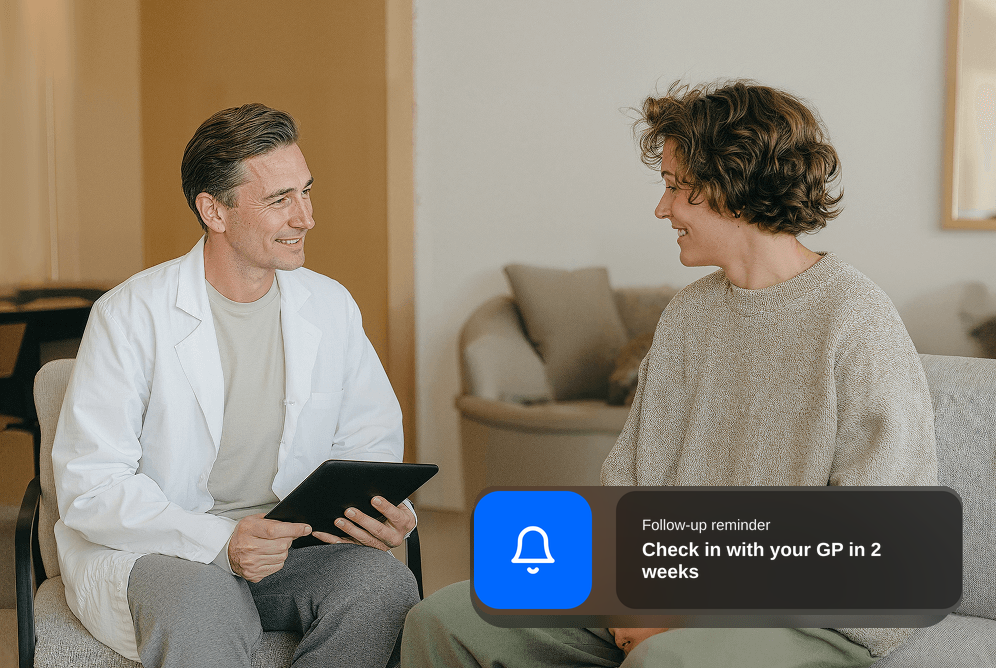
GP follow-up reminder for ongoing care and progress monitoring
05

Ongoing care and follow-up

Follow-up appointments, progress monitoring and ongoing advice — including saying plainly when something needs in-person or NHS care instead.

Ongoing

How we compare

Time to be seen

Appointment length

Your NHS record in the room

Written treatment plan

Told when a test isn’t needed

Cost

Varies by practice

Typically 10 minutes

Yes, your full record

Not routinely

Usually

Free

Same day

Often 10 to 15 minutes

Usually not

Sometimes charged

Varies by provider

Often a subscription

Questions about our service

How quickly can I be seen?

Same-day access is usually available, from 6am to 10pm, seven days a week. You choose a time that suits you rather than waiting on hold at 8am.

Will I see the same doctor each time?

Yes. Care is led personally by Dr Mohammad Khan, so you are not passed between clinicians. Continuity is the point of a small practice: someone who knows your history and is listening attentively rather than working through a checklist.

Can you see my NHS records?

Yes, with your consent. We can access your Summary Care Record during the consultation, so your current medications, allergies and significant history are in the room. That means fewer questions you have already answered elsewhere, and safer prescribing.

Are you trying to replace my NHS GP?

No. We are not here to replace GPs, only to support them. Your NHS practice remains responsible for your ongoing care, and with your consent we write to them after the consultation. We are useful when you need to be seen sooner, or want more time than a standard appointment allows.

What is included in the appointment?

Twenty unhurried minutes and a comprehensive assessment. A written treatment plan is included, along with any prescription, sick note or referral letter arising from the consultation, at no extra charge.

How much does it cost?

£40 for 20 minutes, self-pay. Membership is optional and never required. Priced for fairness, because we are not here to charge extortionate amounts for access to a doctor.

What does “treatable online” actually mean?

It means the diagnosis can usually be made from your history and photographs, and that treatment can be arranged safely without examining you. Where a condition is not marked treatable online, it is because examination is the diagnosis — listening to a chest, feeling an abdomen, examining an ear or a joint — or because a procedure or device is needed.

Can you prescribe antibiotics?

Yes, where there is a genuine bacterial infection — cellulitis, impetigo, bacterial urine infections, confirmed strep throat. We will also frequently tell you that you do not need one. Most sore throats, coughs, colds and earaches are viral, and an antibiotic gives you the side effects with none of the benefit.

What if the GP cannot help with what I need?

If your problem turns out to be genuinely outside what we can do remotely, the doctor will tell you straight away, point you to the right service, and refund your fee in full. We would rather do that than fill twenty minutes to justify the charge.

What should I do in an emergency?

Call 999 or go to A&E — do not book an online appointment and do not wait for a reply to an email. For urgent problems that are not emergencies, NHS 111 is available 24 hours a day, online or by phone, and can direct you to the right service.

Patient reviews

What our patients say

No reviews published yet.
Ready to see a GP?20 minutes with a GMC-registered doctor. £40, usually same day.
Book a consultation