Skin, hair and nails icon - eczema, psoriasis and rashes assessed by an online GP at Cheshire Clinics
Treatable online

Hair Loss

Some causes are entirely reversible. Working out which you have is the whole task.

£40 · 20 minutes

Same-day availability

6am to 10pm, seven days

Assessed and treated by a GMC-registered GP

Prescriptions, sick notes and referral letters included

A written treatment plan after every appointment

Your NHS records in the room, with your consent

Clinically reviewed by Dr Mohammad Khan · Last reviewed

August 23, 2026

Book a consultation

A 20-minute appointment with a GMC-registered GP for £40. No membership required.

Private GP care led personally by Dr Mohammad Zubair Khan, GMC 7563469.

Why patients choose Cheshire Clinics

GMC registered doctors badge - every Cheshire Clinics consultation is with a General Medical Council registered GP

GMC-registered

Care led personally by Dr Khan

Royal College of General Practitioners badge - RCGP trained private GP consultations at Cheshire Clinics

RCGP-trained

Attentive, unhurried care that listens properly

Google five star reviews badge - Cheshire Clinics private GP online

Highly rated by patients

Five-star Google reviews from the people we have looked after

Care Quality Commission registered badge - Cheshire Clinics online GP service is registered with the CQC, England's independent regulator of health and social care

CQC-registered

Registered with the Care Quality Commission

Same-Day Appointments
Sick Notes
Private Prescriptions
Blood Tests
Menopause & HRT
Weight Management
Mental Health
Specialist Referrals
Same-Day Appointments
Sick Notes
Private Prescriptions
Blood Tests
Menopause & HRT
Weight Management
Mental Health
Specialist Referrals

Overview

Losing 50 to 100 hairs a day is normal. Hair grows in cycles, and at any moment around one in ten follicles is in a resting phase before shedding and regrowing.

Hair loss becomes a problem when the balance shifts — either because more follicles enter the resting phase at once, or because follicles progressively shrink and stop producing visible hair.

The most important distinction is between scarring and non-scarring hair loss, and it is the reason this page exists in the form it does.

Non-scarring hair loss — pattern hair loss, telogen effluvium, alopecia areata — leaves the follicle intact, so regrowth remains possible however long it has been going on. Scarring alopecia destroys the follicle permanently. Hair lost that way does not come back, and the only thing that helps is prompt treatment to stop further loss.

The features that suggest scarring — an itchy, burning or tender scalp, redness, scaling, and smooth shiny patches where the little openings the hairs come from have disappeared — need urgent dermatology assessment. Every month of delay is permanent. This is the single most time-critical thing on this page and it is very often missed.

Common symptoms

Male pattern hair loss

Receding at the temples and thinning at the crown, gradually over years. Very common, and it can begin in the twenties.

Female pattern hair loss

Widening of the parting with general thinning over the crown, while the frontal hairline is preserved. Women notice a thinner ponytail before they notice anything on the scalp.

Telogen effluvium — and the timing that confuses everyone

  • Sudden, diffuse shedding all over the scalp — handfuls in the shower, hair on the pillow and in the brush
  • It happens two to three months after the trigger, not at the time. This is the crucial point: people search for a cause in the weeks before the shedding started, when the real event was a bad flu, an operation, a birth or a period of severe stress a season earlier
  • It is a reaction rather than a disease, and it recovers, usually over six to nine months

Alopecia areata

Smooth, round, completely bald patches appearing over days to weeks, with normal-looking skin. Autoimmune. Often regrows spontaneously.

The pattern that needs urgent attention

  • Itching, burning or tenderness of the scalp
  • Redness, scaling or pustules around the hair follicles
  • Smooth, shiny patches where you can no longer see the tiny follicle openings
  • A hairline moving backwards in a band, particularly in women after the menopause, often with loss of the eyebrows

These suggest scarring alopecia and warrant urgent assessment rather than a wait-and-see approach.

Causes and risk factors

Pattern hair loss

Genetic sensitivity of the follicle to DHT, a testosterone derivative, which progressively shrinks it. Inherited from both sides of the family, not just the mother's — a persistent myth.

Triggers of telogen effluvium — look two to three months back

  • A significant illness, high fever, or COVID
  • Surgery or general anaesthetic
  • Childbirth — extremely common at around three months postpartum, and it recovers
  • Severe stress or bereavement
  • Rapid weight loss or crash dieting, including after bariatric surgery and, increasingly, on GLP-1 weight-loss medication
  • Stopping or starting the contraceptive pill
  • Medication — including some antidepressants, beta blockers, anticoagulants, isotretinoin, and high-dose vitamin A

Nutritional and hormonal causes

  • Iron deficiency — the commonest correctable cause in women, and it does not require anaemia. Ferritin needs to be comfortably above the laboratory cut-off for hair regrowth, which is why women are so often told their iron is "normal" while their hair continues to fall
  • Thyroid disease, both over- and underactive
  • Vitamin D and B12 deficiency; low protein intake
  • PCOS, where hair loss accompanies irregular periods, acne and unwanted facial hair
  • The menopause

Physical and scarring causes

  • Traction alopecia — from tight braids, weaves, extensions and repeated tight ponytails. Reversible early, permanent if it continues, and typically affects the hairline and temples
  • Frontal fibrosing alopecia — a scarring condition affecting the hairline and eyebrows, mainly in postmenopausal women, and increasing in frequency
  • Lichen planopilaris and other scarring alopecias
  • Scalp ringworm — scaly patches with broken hairs, mainly in children, needing oral treatment

How it is diagnosed

The pattern of loss, its speed, and the state of the scalp make the diagnosis. Photographs are genuinely useful here, and this assesses well remotely provided the images are good.

What to photograph before your appointment

  • The parting, in natural daylight, from directly above
  • The crown, from above
  • The frontal hairline, and the temples
  • Close-ups of any redness, scaling or bald patches
  • A photograph from a year or two ago for comparison, if you have one — more informative than any description

Blood tests

  • Ferritin — the most important. Ask for the actual number. A result at the very bottom of the range is frequently reported as normal while being nowhere near enough for hair regrowth
  • Thyroid function
  • Full blood count, vitamin D, B12 and zinc
  • Hormone testing including testosterone in women with irregular periods, acne or unwanted hair growth

What we cannot do remotely, and when it matters

We cannot examine the scalp closely, perform a pull test, use a dermatoscope, or take a biopsy. For anything suggesting a scarring alopecia, that examination is exactly what is needed — so we refer urgently rather than treating on photographs. Scalp biopsy is how these are diagnosed, and time matters.

How we treat it online

1. Correct anything correctable first

Iron, thyroid, vitamin D and B12 — and reviewing any medication that could be responsible. This is straightforward, often overlooked, and can resolve the problem entirely.

Iron is best taken on alternate days, which absorbs better than daily dosing, with vitamin C and away from tea and coffee. Expect three to six months before hair responds — the follicle has to complete its cycle.

2. Telogen effluvium

The treatment is reassurance and time, which is genuinely the right answer rather than a way of not treating. Identify the trigger two to three months back, correct any deficiency, and expect recovery over six to nine months. Hair pulled out in this way regrows — the follicles are intact.

3. Pattern hair loss

  • Topical minoxidil — available over the counter, effective for both men and women, and it works only while used. Expect increased shedding in the first four to eight weeks; this is the treatment working, pushing resting hairs out to make way for new growth, and stopping at that point is the commonest reason it "failed". Give it four to six months
  • Finasteride for men — effective, and prescribed after a proper discussion of sexual side effects, which affect a small proportion. Two practical points: it halves your PSA reading, so any doctor interpreting a PSA must know you take it; and women who are or may become pregnant must not handle crushed or broken tablets
  • Spironolactone for female pattern hair loss, used off-label with reasonable evidence, particularly where PCOS is involved

4. Where we refer urgently

Any suspicion of scarring alopecia goes to dermatology urgently. Redness, scaling, itch, burning, a receding hairline in a band, or loss of the follicle openings. Treatment cannot restore what is lost but can stop further destruction — which makes speed the whole point.

Alopecia areata that is extensive or not recovering also warrants dermatology, where treatments including newer oral medication are available.

Skin, hair and nails consultation - private GP assessment for rashes, acne, eczema and hair loss at Cheshire Clinics

Ready to talk to a GP about this?

Book a consultation
Important

When to seek urgent help

Hair loss is rarely a medical emergency, but some forms are time-critical because the damage becomes permanent.

Arrange assessment urgently — within weeks, not months — for:

  • An itchy, burning, painful or tender scalp with hair loss
  • Redness, scaling or pustules around the follicles
  • Smooth, shiny bald areas where you can no longer see the follicle openings
  • A hairline receding in a band, particularly with thinning eyebrows — frontal fibrosing alopecia, where early treatment protects what remains
  • Rapidly spreading or extensive loss over days to weeks
  • Hair loss with a scaly, boggy or pus-filled scalp in a child — scalp ringworm needs oral treatment and topical products will not clear it

Seek same-day assessment for:

  • Hair loss with a widespread rash, mouth ulcers, joint pains or fever — which may indicate an autoimmune condition
  • Hair loss after starting a new medication, with any rash or feeling unwell

Book a routine consultation for:

  • Sudden diffuse shedding, to identify the trigger and check for deficiency
  • Gradual thinning you want assessed and treated
  • Hair loss with fatigue, weight change, feeling cold, or irregular periods
  • Hair loss with acne and unwanted facial hair in a woman
  • You have been told your iron is normal but your hair is still falling — ask for the actual ferritin number

Prevention and self-care

Protecting the hair you have

  • Stop tight hairstyles. Braids, weaves, extensions and tight ponytails cause traction alopecia, which is entirely reversible early and permanent if it continues. If your scalp hurts or you get small bumps along the hairline, the style is too tight
  • Avoid chemical relaxers and frequent heat styling
  • Be gentle when wet, when hair is most fragile — wide-tooth comb, no vigorous towel-drying
  • Adequate protein, and enough calories. Hair is among the first things the body deprioritises when nutrition is short

What is worth spending money on

  • Minoxidil — the only over-the-counter treatment with solid evidence for pattern hair loss. Persist through the early shedding phase and give it four to six months
  • Correcting a genuine deficiency, once identified by a blood test

What is not

  • Hair growth supplements, in the absence of a deficiency. Biotin is the most heavily marketed and there is no evidence it helps anyone who is not deficient — which is very rare. Worse, biotin interferes with several blood tests, including thyroid and cardiac tests, producing falsely abnormal results. Stop it well before any blood test and tell whoever is testing you
  • Caffeine shampoos, laser combs and most "thickening" products
  • Excess vitamin A, which causes hair loss rather than preventing it

Take photographs

Monthly, in the same light, from the same angles. Hair changes too slowly to judge in a mirror, and photographs are the only reliable way to know whether treatment is working — which matters when a treatment needs six months before it can be judged.

NHS or private

Minoxidil is available over the counter and is the mainstay for pattern hair loss in both men and women. It costs modestly, needs to be used indefinitely, and takes six months before any judgement is possible.

The NHS does not fund treatment for male or female pattern hair loss, treating it as cosmetic — so this is genuinely one of the areas where private care is the only route. That is worth stating plainly rather than sending you on a fruitless NHS journey.

Where the NHS does have a role, and where it matters most, is hair loss that is not pattern hair loss — and distinguishing the two is the single most valuable thing a consultation does.

Blood tests are the honest first step: ferritin, thyroid function, full blood count and vitamin D. Iron deficiency without anaemia is a common and entirely treatable cause of diffuse hair loss in women, and it is regularly missed because the haemoglobin was normal.

What needs a dermatologist rather than a treatment: patchy hair loss with smooth bald areas, scaling or redness of the scalp, and above all any hair loss with scarring — which is permanent and where delay costs hair that will not come back.

Where money is wasted: supplements marketed for hair growth, and laser combs.

Evidence and guidelines

NICE Clinical Knowledge Summary, Hair loss, and Alopecia — androgenetic, are the principal references. They set out topical minoxidil as first-line for pattern hair loss and oral finasteride for men, and note that NHS treatment is not routinely funded for androgenetic alopecia.

CKS recommends investigating for underlying causes in diffuse or unexplained hair loss — including ferritin, thyroid function, full blood count and, where indicated, autoimmune screening.

CKS identifies telogen effluvium following illness, surgery, childbirth or significant stress, which is self-limiting and recovers without treatment — an important distinction from progressive loss.

British Association of Dermatologists guidelines cover alopecia areata and the scarring alopecias, and are explicit that scarring alopecia requires urgent specialist assessment, since follicular destruction is irreversible.

CKS covers tinea capitis as a cause of patchy loss with scaling in children, requiring systemic antifungal treatment.

Common questions

Why did my hair start falling out months after I was ill?

Because that is exactly how telogen effluvium works. A shock — illness, surgery, childbirth, severe stress, rapid weight loss — pushes many follicles into the resting phase at once, and they shed together two to three months later. People look for a cause in the wrong period entirely. It recovers over six to nine months.

My iron was normal but my hair is still falling out. Why?

Ask for the actual ferritin number rather than accepting "normal". The level required for hair regrowth is well above the level a laboratory flags as low, so a result at the bottom of the range gets reported as normal while being nowhere near sufficient. This is one of the commonest frustrations in hair loss and it is entirely avoidable.

My hair got worse after starting minoxidil. Should I stop?

No — that is the treatment working. Increased shedding in the first four to eight weeks happens because resting hairs are pushed out to make room for new growth. Stopping at that point is the commonest reason minoxidil is abandoned. Persist and give it four to six months.

Will it grow back?

It depends entirely on whether the follicle survives. Telogen effluvium, alopecia areata and pattern hair loss all leave the follicle intact, so regrowth is possible. Scarring alopecia destroys it, and that loss is permanent — which is why an itchy, scaly or shiny scalp needs urgent assessment rather than watchful waiting.

Are hair supplements worth taking?

Only to correct a proven deficiency. Biotin in particular has no evidence of benefit in people who are not deficient, and it interferes with blood tests including thyroid and cardiac markers, producing false results. Stop it before any blood test and mention it.

Do braids and extensions really cause it?

Yes. Traction alopecia from tight styling is common, typically affects the hairline and temples, and is fully reversible if caught early and permanent if it continues. Scalp soreness or small bumps along the hairline mean the tension is too high. Loosening the style now protects hair that will not come back later.

Is finasteride safe?

For most men, yes, and it is effective. Sexual side effects affect a small proportion and generally resolve on stopping. Two things must be known: it halves your PSA reading, so anyone interpreting a prostate test must be told; and pregnant women must not handle broken tablets.

Is it from my mother's side?

Not only. Pattern hair loss is inherited from both parents, and the idea that it comes solely from your mother's father is a myth. Family history on either side raises your likelihood.


Dr Mohammad Zubair Khan, GMC-registered private GP and founder of Cheshire Clinics
Clinically reviewed by Dr Mohammad Zubair Khan, GMC 7563469
Last reviewed

August 23, 2026

How it works

What happens when you book

£40 for a 20-minute appointment with a GMC-registered GP, 6am to 10pm, seven days a week. Membership is optional and never required.
Cheshire Clinics online GP appointment booking confirmation on mobile
01

Book your appointment

Pick a time that suits you — 6am to 10pm, seven days a week, including weekends and bank holidays. £40 for 20 minutes, self-pay, with no insurance to arrange.
5–10 minutes
Online video consultation with a GMC-registered private GP
02

Meet your GP

A 20-minute video or phone consultation with a GMC-registered GP — long enough for a proper conversation about your symptoms, your history and what matters to you.
20 minutes
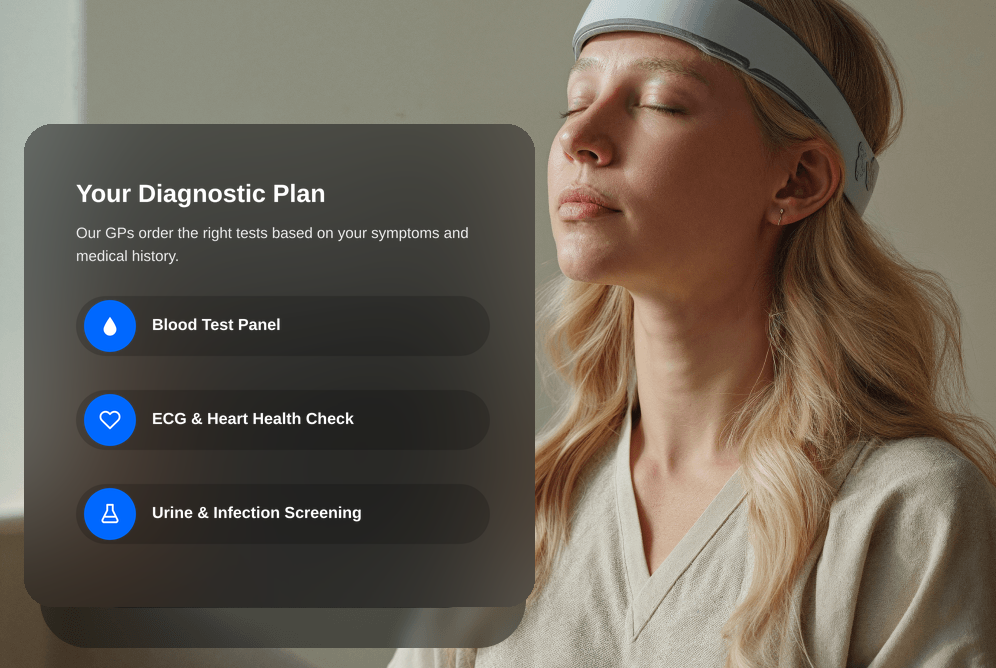
Diagnostic testing plan including blood test panel, ECG and urine screening
03

Tests and referrals, if you need them

Where testing will actually answer the question, we arrange it — blood tests and health screening through our laboratory partner, or a referral for ultrasound, X-ray, CT or MRI through private imaging providers. We will also tell you when a scan is not the right next step.
1–7 days
Personalised results and treatment plan from a private GP consultation
04

Results and next steps

Your GP talks you through what the results mean and agrees the next step with you. Every consultation ends with your treatment plan in writing, and any prescription goes to your own pharmacy.
20 minutes
GP follow-up reminder for ongoing care and progress monitoring
05

Ongoing care and follow-up

Follow-up appointments, progress monitoring and ongoing advice — including saying plainly when something needs in-person or NHS care instead.

Ongoing

How we compare

Time to be seen

Appointment length

Your NHS record in the room

Written treatment plan

Told when a test isn’t needed

Cost

Varies by practice

Typically 10 minutes

Yes, your full record

Not routinely

Usually

Free

Same day

Often 10 to 15 minutes

Usually not

Sometimes charged

Varies by provider

Often a subscription

Questions about our service

How quickly can I be seen?

Same-day access is usually available, from 6am to 10pm, seven days a week. You choose a time that suits you rather than waiting on hold at 8am.

Will I see the same doctor each time?

Yes. Care is led personally by Dr Mohammad Khan, so you are not passed between clinicians. Continuity is the point of a small practice: someone who knows your history and is listening attentively rather than working through a checklist.

Can you see my NHS records?

Yes, with your consent. We can access your Summary Care Record during the consultation, so your current medications, allergies and significant history are in the room. That means fewer questions you have already answered elsewhere, and safer prescribing.

Are you trying to replace my NHS GP?

No. We are not here to replace GPs, only to support them. Your NHS practice remains responsible for your ongoing care, and with your consent we write to them after the consultation. We are useful when you need to be seen sooner, or want more time than a standard appointment allows.

What is included in the appointment?

Twenty unhurried minutes and a comprehensive assessment. A written treatment plan is included, along with any prescription, sick note or referral letter arising from the consultation, at no extra charge.

How much does it cost?

£40 for 20 minutes, self-pay. Membership is optional and never required. Priced for fairness, because we are not here to charge extortionate amounts for access to a doctor.

What does “treatable online” actually mean?

It means the diagnosis can usually be made from your history and photographs, and that treatment can be arranged safely without examining you. Where a condition is not marked treatable online, it is because examination is the diagnosis — listening to a chest, feeling an abdomen, examining an ear or a joint — or because a procedure or device is needed.

Can you prescribe antibiotics?

Yes, where there is a genuine bacterial infection — cellulitis, impetigo, bacterial urine infections, confirmed strep throat. We will also frequently tell you that you do not need one. Most sore throats, coughs, colds and earaches are viral, and an antibiotic gives you the side effects with none of the benefit.

What if the GP cannot help with what I need?

If your problem turns out to be genuinely outside what we can do remotely, the doctor will tell you straight away, point you to the right service, and refund your fee in full. We would rather do that than fill twenty minutes to justify the charge.

What should I do in an emergency?

Call 999 or go to A&E — do not book an online appointment and do not wait for a reply to an email. For urgent problems that are not emergencies, NHS 111 is available 24 hours a day, online or by phone, and can direct you to the right service.

Patient reviews

What our patients say

No reviews published yet.
Ready to see a GP?20 minutes with a GMC-registered doctor. £40, usually same day.
Book a consultation