Home

/

Treatments

/

Cholesterol Medication

Cholesterol Medication

Whether you need a statin depends on your overall cardiovascular risk, not your cholesterol number alone.

From £40

Everyday & Long-Term

Assessed and prescribed by a GMC-registered GP

Prescriptions sent electronically to a pharmacy

Monitoring and follow-up included where it is needed

Your NHS records in the room, with your consent

Clinically reviewed by Dr Mohammad Khan · Last reviewed

August 23, 2026

Book a consultation

A 20-minute appointment with a GMC-registered GP for £40. Same-day appointments are usually available, 6am to 10pm, seven days a week.

Private GP care led personally by Dr Mohammad Zubair Khan, GMC 7563469.

Why patients choose Cheshire Clinics

GMC registered doctors badge - every Cheshire Clinics consultation is with a General Medical Council registered GP

GMC-registered

Care led personally by Dr Khan

Royal College of General Practitioners badge - RCGP trained private GP consultations at Cheshire Clinics

RCGP-trained

Attentive, unhurried care that listens properly

Google five star reviews badge - Cheshire Clinics private GP online

Highly rated by patients

Five-star Google reviews from the people we have looked after

Care Quality Commission registered badge - Cheshire Clinics online GP service is registered with the CQC, England's independent regulator of health and social care

CQC-registered

Registered with the Care Quality Commission

Same-Day Appointments
Sick Notes
Private Prescriptions
Blood Tests
Menopause & HRT
Weight Management
Mental Health
Specialist Referrals
Same-Day Appointments
Sick Notes
Private Prescriptions
Blood Tests
Menopause & HRT
Weight Management
Mental Health
Specialist Referrals

Overview

Cholesterol medication is one of the most-prescribed and most-argued-about treatments in the UK. The decision to take it should rest on your overall cardiovascular risk — age, blood pressure, smoking, diabetes, family history and cholesterol together — not on a single number on a blood test.

We will calculate that risk with you properly and explain what the benefit actually looks like in your case, rather than issuing a prescription because a figure looked high.

What it is

Statins — atorvastatin, simvastatin, rosuvastatin — reduce the cholesterol your liver produces. They are first-line and have the largest evidence base of any preventive medication.

Ezetimibe reduces cholesterol absorbed from food. Used alongside a statin, or alone if statins are not tolerated.

Bempedoic acid and injectable PCSK9 inhibitors are newer options for people who cannot take statins or need further reduction, generally initiated in specialist lipid clinics.

Who it's suitable for

  • People with a calculated 10-year cardiovascular risk of 10% or more
  • Anyone who has had a heart attack, stroke, angina or arterial disease — where treatment is recommended regardless of the cholesterol level
  • People with type 2 diabetes and additional risk factors
  • People with familial hypercholesterolaemia — an inherited condition affecting roughly 1 in 250 people, substantially underdiagnosed, and a reason to treat from a much younger age
  • Anyone with a very high cholesterol level irrespective of calculated risk

How treatment works

1. Consultation

We take a full cardiovascular history — family history of early heart disease matters enormously and is frequently not asked about.

2. Testing

A full lipid profile, plus HbA1c, thyroid function, kidney and liver function. An underactive thyroid raises cholesterol and is a reversible cause worth excluding first.

3. Risk calculation

We use QRISK3 and show you the actual number — including what it becomes with and without treatment, so the decision is yours on real figures.

4. Prescription and monitoring

Liver function is rechecked at 3 months, and lipids repeated to confirm response.

Ready to start treatment?

Book a consultation

What's included

  • 20-minute consultation with a GMC-registered GP
  • Formal QRISK3 cardiovascular risk calculation, explained
  • Lipid profile and baseline bloods arranged
  • Private prescription where appropriate, to your own pharmacy
  • A written summary of the discussion
  • Follow-up bloods and dose review

Safety and side effects

Statins are well tolerated by most people, but the side-effect conversation is worth having honestly.

Muscle aches are the commonest complaint. In blind trials, rates of muscle symptoms are similar on statin and placebo — which does not mean your symptoms are imagined, but does mean that switching statin, lowering the dose or trying alternate-day dosing is often successful where stopping altogether is not necessary.

Liver enzymes can rise; this is why we check at baseline and 3 months. Significant liver injury is rare.

A small increase in the risk of developing type 2 diabetes is real and worth knowing about, and is outweighed by the cardiovascular benefit in people at genuine risk.

Grapefruit juice interacts with simvastatin and atorvastatin. Statins interact with several other drugs, including some antibiotics — tell us everything you take.

Not suitable if

  • You are pregnant, planning pregnancy or breastfeeding — statins are contraindicated
  • You have active liver disease or persistently raised liver enzymes
  • You have had a genuine severe reaction to statins, including rhabdomyolysis
  • You are taking a medication with a serious interaction that cannot be changed

If you develop severe, widespread muscle pain with dark urine, stop the statin and seek medical attention the same day.

Monitoring and follow-up

The schedule

  • Liver function and lipids at 3 months — checking the response and that the liver is content
  • Again at 12 months, then annually
  • Repeat bloods after any dose change

The target is usually a reduction of 40% or more in non-HDL cholesterol from baseline. If that has not happened, the questions are adherence, dose, and whether to add ezetimibe — in that order.

Muscle symptoms — handled properly rather than by stopping

Muscle aches are the commonest complaint, and the commonest reason people abandon a statin permanently. That is usually avoidable.

  • Stop temporarily and see whether symptoms actually resolve. Then rechallenge — the majority of people who thought they could not tolerate statins tolerate one on a second attempt, often at a lower dose or a different drug
  • Switch statin, lower the dose, or try alternate-day dosing, all of which work for a great many people
  • Check thyroid and vitamin D, both of which cause muscle aches in their own right and are frequently the real explanation

Stop and seek same-day medical attention for severe, widespread muscle pain with weakness or dark urine. Rhabdomyolysis is rare and serious, and is quite different from an ache.

What is being watched

  • Liver enzymes — mild rises are common and rarely a reason to stop; significant liver injury is rare
  • HbA1c — there is a small real increase in the risk of developing type 2 diabetes, outweighed by the cardiovascular benefit in anyone at genuine risk
  • Everything else in the risk picture — blood pressure, smoking, weight, activity. A statin is one part of it, not the whole of it

Interactions to keep in mind

Grapefruit juice with simvastatin and atorvastatin. Certain antibiotics — clarithromycin in particular — where a statin is usually paused for the course. Also some antifungals and HIV medicines.

Tell any prescriber that you take a statin, and tell us about anything new.

This is long-term treatment

Cholesterol rises again when a statin stops. The benefit accrues over years of taking it, which is why adherence matters more here than almost anywhere — and why an honest conversation about side effects, rather than silent discontinuation, is what makes the difference.

Alternatives

What the decision should actually rest on

Overall cardiovascular risk — age, blood pressure, smoking, diabetes, family history and cholesterol together — not a single number on a blood test.

We calculate QRISK3 and show you the figure, with and without treatment, so the decision is yours on real numbers rather than on a lab result that looked high.

Reversible causes worth excluding first

  • An underactive thyroid raises cholesterol and is a reversible cause — treating it can resolve the problem entirely, and it is routinely not checked
  • Poorly controlled diabetes, kidney or liver disease, and heavy alcohol use
  • Certain medicines, including some steroids and antiretrovirals

Diet and lifestyle — what actually moves the number

  • Replacing saturated fat with unsaturated fat — the change with the best evidence, and more effective than cutting fat generally
  • Soluble fibre — oats, beans, pulses
  • Plant stanols and sterols, in the fortified spreads and drinks, which produce a genuine if modest reduction
  • Exercise, weight and stopping smoking, all of which affect overall risk more than they affect the LDL number

Honest framing: lifestyle change alone rarely achieves what a statin achieves — but it improves overall risk, and it is worth doing whether or not you take a tablet.

Other medication

  • Ezetimibe — added to a statin, or used alone where statins are not tolerated. Well tolerated, and does not cause muscle symptoms
  • Bempedoic acid, for people who genuinely cannot take statins
  • PCSK9 inhibitors — injectable, highly effective, specialist-initiated through NHS lipid clinics for people with very high risk or familial hypercholesterolaemia

The condition worth not missing

Familial hypercholesterolaemia affects roughly 1 in 250 people and is substantially underdiagnosed. It is inherited, causes very high cholesterol from birth, and carries a high risk of early heart disease.

Suspect it with very high cholesterol, a family history of heart attack under 60, or tendon thickening. It needs specialist assessment, treatment from a younger age, and testing of relatives — which is where the real benefit lies.

What does not work

Red yeast rice — which contains a statin in unregulated quantity, so you get the drug without the dosing or the monitoring. Omega-3 supplements for cholesterol lowering. And expensive private cardiac screening where a QRISK calculation and a lipid profile would tell you what you need.

Costs explained

What you pay us

  • £40 for the consultation, including a formal QRISK3 calculation explained properly, and a written summary
  • Lipid profile and baseline bloods, quoted before arranging
  • £40 for review, with liver function and lipids repeated at 3 months

What you pay the pharmacy

Atorvastatin and simvastatin are among the cheapest medicines in the NHS formulary — a few pounds a month privately. Ezetimibe is also generic and inexpensive.

We earn nothing from what is prescribed.

Where the appointment earns its money

The decision, not the prescription. A statin is a long-term commitment, and it should follow a proper risk calculation rather than a lab result that looked high.

  • Twenty minutes to see your actual QRISK figure, with and without treatment, and decide on that
  • Checking the thyroid, which raises cholesterol and is a reversible cause routinely missed
  • Family history, which matters enormously and is frequently not asked about
  • Rechallenging someone who "cannot take statins" — most can, on a different drug or dose

The NHS point

Statins are prescribed free on the NHS in Scotland, Wales and Northern Ireland, and at the standard charge in England — with structured annual review. If you are registered with a GP, that is the cheaper and better-joined-up route for a lifelong treatment.

Where not to spend money

  • Red yeast rice supplements — an unregulated statin with no dosing control and no monitoring
  • Omega-3 supplements for lowering cholesterol
  • Expensive private cardiac screening packages before a QRISK calculation and a lipid profile, which cost a fraction and answer the question

We sell nothing.

Common questions

Should I take a statin at all?

That depends on your overall cardiovascular risk rather than on your cholesterol number alone.

We calculate QRISK3 and show you the figure — including what it becomes with and without treatment. The decision is yours, made on real numbers rather than on a result that looked high on a printout.

Treatment is usually recommended at a 10-year risk of 10% or more, and after any heart attack, stroke or arterial disease regardless of the cholesterol level.

Do statins really cause muscle aches?

Here is the honest version. Muscle aches are the commonest complaint — but in blinded trials, rates are similar on statin and on placebo.

That does not mean your symptoms are imagined. It means that before abandoning statins altogether, it is worth stopping temporarily to see whether they resolve, then rechallenging — and most people who believed they could not tolerate statins do tolerate one, at a lower dose or as a different drug.

It is also worth checking thyroid and vitamin D, which cause muscle aches in their own right.

When are muscle symptoms serious?

Severe, widespread muscle pain with weakness or dark urine. Stop the statin and seek medical attention the same day.

That is rhabdomyolysis, it is rare, and it is quite different from an ache.

Do statins cause diabetes?

There is a small real increase in the risk of developing type 2 diabetes, mostly in people already close to the threshold.

It is outweighed by the cardiovascular benefit in anyone at genuine risk, and it is a reason to monitor HbA1c rather than to avoid treatment. You should hear about it rather than discover it later.

Can I lower it with diet instead?

Diet helps, and lifestyle change alone rarely achieves what a statin achieves — both are true.

Replacing saturated fat with unsaturated fat is the change with the best evidence, alongside soluble fibre and plant stanols. It is worth doing whether or not you take a tablet, because it improves overall risk.

Do I have to take it for life?

Generally yes — cholesterol rises again when it stops. The benefit accrues over years, which is why consistency matters more here than in most treatments.

Does it matter what time I take it?

For simvastatin, yes — in the evening. Atorvastatin and rosuvastatin are long-acting and can be taken at any time, which makes them easier to remember.

What about grapefruit?

Genuinely relevant with simvastatin and atorvastatin — it raises drug levels and increases the risk of muscle problems. Rosuvastatin and pravastatin are not affected.

Also tell any prescriber you take a statin, since certain antibiotics — clarithromycin especially — interact, and the statin is usually paused for the course.

My cholesterol is very high and my father had a heart attack at 50.

That combination should prompt assessment for familial hypercholesterolaemia — an inherited condition affecting roughly 1 in 250 people, substantially underdiagnosed, and a reason to treat from a much younger age.

It also means testing relatives, which is where much of the benefit lies. It needs specialist assessment, and referral is free on the NHS.

Is there an alternative if I truly cannot take statins?

Yes — ezetimibe, which is well tolerated and does not cause muscle symptoms, and bempedoic acid. For very high risk, PCSK9 inhibitors are available through NHS lipid clinics.

Nobody should be left untreated because a statin did not suit them.

Should I take red yeast rice instead?

No — it contains a statin, in an unregulated quantity. So you take the drug without knowing the dose, without monitoring, and with the same interactions and side effects.

That is the worst of both worlds, and a prescribed generic statin costs less.

Dr Mohammad Zubair Khan, GMC-registered private GP and founder of Cheshire Clinics

Clinically reviewed by Dr Mohammad Zubair Khan, GMC 7563469

Last reviewed

August 23, 2026

How it works

What happens when you book

£40 for a 20-minute appointment with a GMC-registered GP, 6am to 10pm, seven days a week. Membership is optional and never required.
Cheshire Clinics online GP appointment booking confirmation on mobile
01

Book your appointment

Pick a time that suits you — 6am to 10pm, seven days a week, including weekends and bank holidays. £40 for 20 minutes, self-pay, with no insurance to arrange.
5–10 minutes
Online video consultation with a GMC-registered private GP
02

Meet your GP

A 20-minute video or phone consultation with a GMC-registered GP — long enough for a proper conversation about your symptoms, your history and what matters to you.
20 minutes
Diagnostic testing plan including blood test panel, ECG and urine screening
03

Tests and referrals, if you need them

Where testing will actually answer the question, we arrange it — blood tests and health screening through our laboratory partner, or a referral for ultrasound, X-ray, CT or MRI through private imaging providers. We will also tell you when a scan is not the right next step.
1–7 days
Personalised results and treatment plan from a private GP consultation
04

Results and next steps

Your GP talks you through what the results mean and agrees the next step with you. Every consultation ends with your treatment plan in writing, and any prescription goes to your own pharmacy.
20 minutes
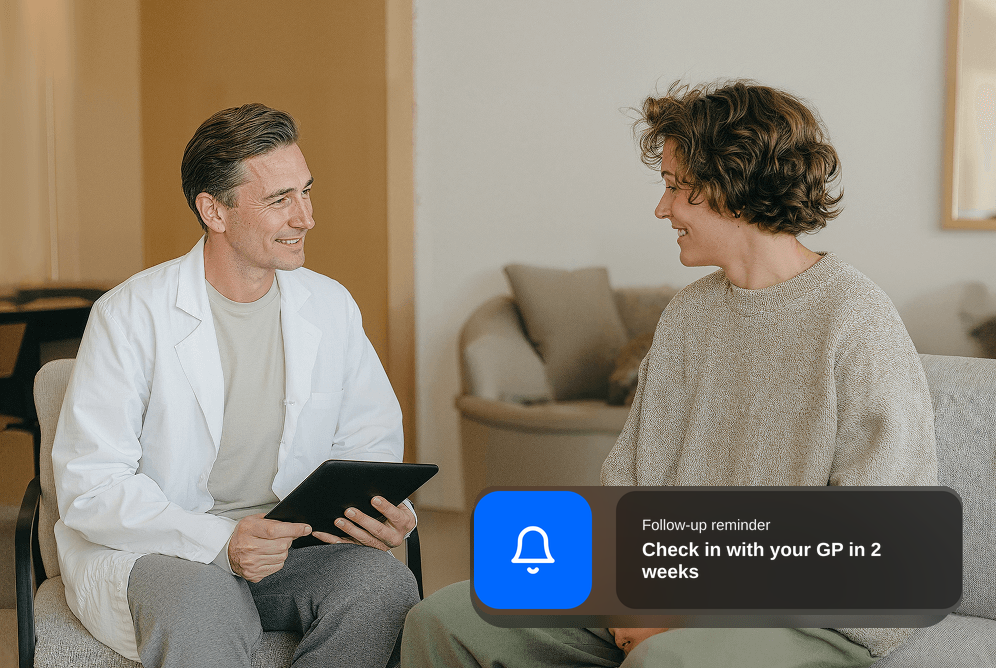
GP follow-up reminder for ongoing care and progress monitoring
05

Ongoing care and follow-up

Follow-up appointments, progress monitoring and ongoing advice — including saying plainly when something needs in-person or NHS care instead.

Ongoing

How we compare

Time to be seen

Appointment length

Your NHS record in the room

Written treatment plan

Told when a test isn’t needed

Cost

Varies by practice

Typically 10 minutes

Yes, your full record

Not routinely

Usually

Free

Same day

Often 10 to 15 minutes

Usually not

Sometimes charged

Varies by provider

Often a subscription

Questions about our service

How quickly can I be seen?

Same-day access is usually available, from 6am to 10pm, seven days a week. You choose a time that suits you rather than waiting on hold at 8am.

Will I see the same doctor each time?

Yes. Care is led personally by Dr Mohammad Khan, so you are not passed between clinicians. Continuity is the point of a small practice: someone who knows your history and is listening attentively rather than working through a checklist.

Can you see my NHS records?

Yes, with your consent. We can access your Summary Care Record during the consultation, so your current medications, allergies and significant history are in the room. That means fewer questions you have already answered elsewhere, and safer prescribing.

Are you trying to replace my NHS GP?

No. We are not here to replace GPs, only to support them. Your NHS practice remains responsible for your ongoing care, and with your consent we write to them after the consultation. We are useful when you need to be seen sooner, or want more time than a standard appointment allows.

What is included in the appointment?

Twenty unhurried minutes and a comprehensive assessment. A written treatment plan is included, along with any prescription, sick note or referral letter arising from the consultation, at no extra charge.

How much does it cost?

£40 for 20 minutes, self-pay. Membership is optional and never required. Priced for fairness, because we are not here to charge extortionate amounts for access to a doctor.

What does “treatable online” actually mean?

It means the diagnosis can usually be made from your history and photographs, and that treatment can be arranged safely without examining you. Where a condition is not marked treatable online, it is because examination is the diagnosis — listening to a chest, feeling an abdomen, examining an ear or a joint — or because a procedure or device is needed.

Can you prescribe antibiotics?

Yes, where there is a genuine bacterial infection — cellulitis, impetigo, bacterial urine infections, confirmed strep throat. We will also frequently tell you that you do not need one. Most sore throats, coughs, colds and earaches are viral, and an antibiotic gives you the side effects with none of the benefit.

What if the GP cannot help with what I need?

If your problem turns out to be genuinely outside what we can do remotely, the doctor will tell you straight away, point you to the right service, and refund your fee in full. We would rather do that than fill twenty minutes to justify the charge.

What should I do in an emergency?

Call 999 or go to A&E — do not book an online appointment and do not wait for a reply to an email. For urgent problems that are not emergencies, NHS 111 is available 24 hours a day, online or by phone, and can direct you to the right service.

Patient reviews

What our patients say

No reviews published yet.
Ready to see a GP?20 minutes with a GMC-registered doctor. £40, usually same day.
Book a consultation