Home

/

Medicines A-Z

/

Solifenacin

Solifenacin

Helps urgency and frequency — and carries an anticholinergic burden worth weighing, especially over 65.

Urinary & Sexual Health

Vesicare, antimuscarinic, anticholinergic

Explained by a GMC-registered GP, not a leaflet

Honest about what we can and cannot prescribe remotely

Side effects given the same weight as benefits

Your NHS records in the room, with your consent

Clinically reviewed by Dr Mohammad Khan · Last reviewed

August 30, 2026

Book a consultation

A 20-minute appointment with a GMC-registered GP for £40. Same-day appointments are usually available, 6am to 10pm, seven days a week.

Private GP care led personally by Dr Mohammad Zubair Khan, GMC 7563469.

Why patients choose Cheshire Clinics

GMC registered doctors badge - every Cheshire Clinics consultation is with a General Medical Council registered GP

GMC-registered

Care led personally by Dr Khan

Royal College of General Practitioners badge - RCGP trained private GP consultations at Cheshire Clinics

RCGP-trained

Attentive, unhurried care that listens properly

Google five star reviews badge - Cheshire Clinics private GP online

Highly rated by patients

Five-star Google reviews from the people we have looked after

Care Quality Commission registered badge - Cheshire Clinics online GP service is registered with the CQC, England's independent regulator of health and social care

CQC-registered

Registered with the Care Quality Commission

Same-Day Appointments
Sick Notes
Private Prescriptions
Blood Tests
Menopause & HRT
Weight Management
Mental Health
Specialist Referrals
Same-Day Appointments
Sick Notes
Private Prescriptions
Blood Tests
Menopause & HRT
Weight Management
Mental Health
Specialist Referrals

What it is

Solifenacin is an antimuscarinic, also called an anticholinergic. It blocks the receptors that make the bladder muscle contract, so the bladder holds more and contracts less unpredictably.

Those same receptors exist in the mouth, gut, eyes and brain, which is why the side effects are so predictable: dry mouth, constipation, blurred vision and, in older people, confusion.

Solifenacin is relatively bladder-selective, which is why it is often preferred over older drugs such as oxybutynin.

What it is used for

  • Overactive bladder — urgency, frequency, and urge incontinence
  • Neurogenic bladder overactivity

It treats the urgency type of incontinence, not the stress type. Leaking on coughing, laughing or exercising is stress incontinence, and antimuscarinics do not help that — pelvic floor training and, sometimes, surgery do.

How to take it

  • 5mg once daily, increased to 10mg if needed and tolerated
  • Take it with or without food, swallowed whole, at the same time each day

Give it time

Allow four weeks at a dose before judging it, and expect improvement rather than cure — typically fewer urgent episodes rather than none.

Practical management of side effects

  • Dry mouth: sip water, chew sugar-free gum, use a saliva substitute. It is the commonest reason people stop
  • Constipation: fluid, fibre, and a laxative if needed — anticipate it rather than react to it

Need this reviewed or prescribed?

Book a consultation

Side effects

Common

  • Dry mouth — very common
  • Constipation
  • Blurred vision
  • Indigestion
  • Urinary retention, or difficulty emptying fully

Important in older people

Antimuscarinics contribute to "anticholinergic burden" — the cumulative effect of all such medicines a person takes. A high burden is associated with confusion, falls and, on observational evidence, an increased risk of dementia.

Several common medicines add to it, including amitriptyline, older antihistamines and some bladder and Parkinson's drugs. This is worth totalling up rather than considering drug by drug, and it is a good reason for a medication review.

Not suitable if

  • You have urinary retention, or do not empty your bladder fully
  • You have untreated narrow-angle glaucoma
  • You have significant gastrointestinal obstruction or severe constipation
  • You have myasthenia gravis
  • You have severe kidney or liver impairment, without dose reduction

Considerable caution applies in frail older people, where the risks of confusion and falls may outweigh a modest bladder benefit.

Interactions and monitoring

  • Other anticholinergic medicines — amitriptyline, older antihistamines, oxybutynin, some antipsychotics. The burden is cumulative
  • Ketoconazole and ritonavir — raise levels; lower doses needed
  • Medicines that prolong the QT interval

Monitoring

  • Whether it is actually helping — reviewed at four weeks, and periodically after that
  • Bladder emptying, where retention is a concern
  • Cognition in older people, and total anticholinergic burden

Treatment should be reviewed rather than repeated indefinitely. Many people stay on bladder medication for years without anyone asking whether it still helps.

Can we prescribe this?

Yes, to continue established treatment, and to start it where overactive bladder has been properly assessed and conservative measures have been tried.

What comes first is not a tablet. Bladder training, reducing caffeine and alcohol, and supervised pelvic floor exercises are genuinely effective, and guidelines put them ahead of medication for good reason.

What needs assessment rather than treatment: blood in the urine, pain, recurrent infection, symptoms in a man that might be prostatic, and any suggestion of incomplete bladder emptying — because an antimuscarinic makes retention worse.

Cost and supply

Solifenacin is available as a generic and is inexpensive.

Mirabegron, an alternative working by a different mechanism, costs more but avoids anticholinergic effects entirely — which frequently makes it the better choice in older people despite the price.

Bladder training and pelvic floor physiotherapy are free on the NHS and should be tried first.

Stopping or switching

It can be stopped without tapering. Symptoms return, so it is worth having tried conservative measures alongside so there is something to fall back on.

If it is not working or not tolerated

  • Mirabegron — a beta-3 agonist. Different mechanism, no dry mouth or constipation, the usual choice where anticholinergic burden matters. It can raise blood pressure, so that is monitored
  • Oxybutynin — cheaper but higher anticholinergic burden; generally avoided in older people
  • Tolterodine, darifenacin, fesoterodine — similar alternatives
  • Botulinum toxin into the bladder, or nerve stimulation, under specialist care

What helps regardless

  • Supervised pelvic floor muscle training — effective, and effective for stress incontinence too
  • Bladder training to gradually extend the interval between visits
  • Reducing caffeine, alcohol and fizzy drinks, all of which irritate the bladder directly
  • Vaginal oestrogen after the menopause, which helps urgency and recurrent infection and is consistently underused

Common questions

Why is my mouth so dry?

Because the drug blocks the same receptors in the salivary glands as in the bladder. It is the commonest reason people stop. Sugar-free gum and saliva substitutes help; mirabegron avoids it altogether.

Will it help leaking when I cough?

No — that is stress incontinence, and this drug does not treat it. Pelvic floor training is the treatment for that, and the distinction matters.

Is it linked to dementia?

Anticholinergic medicines as a group have been associated with increased dementia risk in observational studies. The evidence cannot prove cause, but it is a real consideration — and a reason to review the total burden and to prefer mirabegron in older people.

How long before it works?

Up to four weeks. Expect fewer urgent episodes rather than none.

Can I just do the exercises instead?

Often yes, and it is worth trying properly first. Supervised pelvic floor training over at least three months is genuinely effective and has no side effects.

Dr Mohammad Zubair Khan, GMC-registered private GP and founder of Cheshire Clinics

Clinically reviewed by Dr Mohammad Zubair Khan, GMC 7563469

Last reviewed

August 30, 2026

How it works

What happens when you book

£40 for a 20-minute appointment with a GMC-registered GP, 6am to 10pm, seven days a week. Membership is optional and never required.
Cheshire Clinics online GP appointment booking confirmation on mobile
01

Book your appointment

Pick a time that suits you — 6am to 10pm, seven days a week, including weekends and bank holidays. £40 for 20 minutes, self-pay, with no insurance to arrange.
5–10 minutes
Online video consultation with a GMC-registered private GP
02

Meet your GP

A 20-minute video or phone consultation with a GMC-registered GP — long enough for a proper conversation about your symptoms, your history and what matters to you.
20 minutes
Diagnostic testing plan including blood test panel, ECG and urine screening
03

Tests and referrals, if you need them

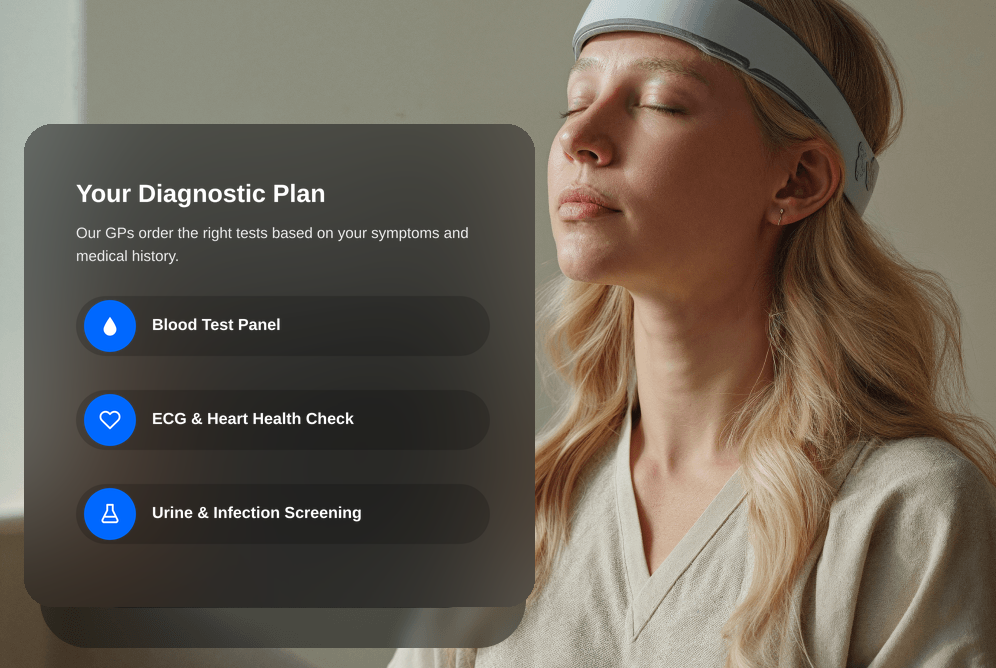
Where testing will actually answer the question, we arrange it — blood tests and health screening through our laboratory partner, or a referral for ultrasound, X-ray, CT or MRI through private imaging providers. We will also tell you when a scan is not the right next step.
1–7 days
Personalised results and treatment plan from a private GP consultation
04

Results and next steps

Your GP talks you through what the results mean and agrees the next step with you. Every consultation ends with your treatment plan in writing, and any prescription goes to your own pharmacy.
20 minutes
GP follow-up reminder for ongoing care and progress monitoring
05

Ongoing care and follow-up

Follow-up appointments, progress monitoring and ongoing advice — including saying plainly when something needs in-person or NHS care instead.

Ongoing

How we compare

Time to be seen

Appointment length

Your NHS record in the room

Written treatment plan

Told when a test isn’t needed

Cost

Varies by practice

Typically 10 minutes

Yes, your full record

Not routinely

Usually

Free

Same day

Often 10 to 15 minutes

Usually not

Sometimes charged

Varies by provider

Often a subscription

Questions about our service

How quickly can I be seen?

Same-day access is usually available, from 6am to 10pm, seven days a week. You choose a time that suits you rather than waiting on hold at 8am.

Will I see the same doctor each time?

Yes. Care is led personally by Dr Mohammad Khan, so you are not passed between clinicians. Continuity is the point of a small practice: someone who knows your history and is listening attentively rather than working through a checklist.

Can you see my NHS records?

Yes, with your consent. We can access your Summary Care Record during the consultation, so your current medications, allergies and significant history are in the room. That means fewer questions you have already answered elsewhere, and safer prescribing.

Are you trying to replace my NHS GP?

No. We are not here to replace GPs, only to support them. Your NHS practice remains responsible for your ongoing care, and with your consent we write to them after the consultation. We are useful when you need to be seen sooner, or want more time than a standard appointment allows.

What is included in the appointment?

Twenty unhurried minutes and a comprehensive assessment. A written treatment plan is included, along with any prescription, sick note or referral letter arising from the consultation, at no extra charge.

How much does it cost?

£40 for 20 minutes, self-pay. Membership is optional and never required. Priced for fairness, because we are not here to charge extortionate amounts for access to a doctor.

What does “treatable online” actually mean?

It means the diagnosis can usually be made from your history and photographs, and that treatment can be arranged safely without examining you. Where a condition is not marked treatable online, it is because examination is the diagnosis — listening to a chest, feeling an abdomen, examining an ear or a joint — or because a procedure or device is needed.

Can you prescribe antibiotics?

Yes, where there is a genuine bacterial infection — cellulitis, impetigo, bacterial urine infections, confirmed strep throat. We will also frequently tell you that you do not need one. Most sore throats, coughs, colds and earaches are viral, and an antibiotic gives you the side effects with none of the benefit.

What if the GP cannot help with what I need?

If your problem turns out to be genuinely outside what we can do remotely, the doctor will tell you straight away, point you to the right service, and refund your fee in full. We would rather do that than fill twenty minutes to justify the charge.

What should I do in an emergency?

Call 999 or go to A&E — do not book an online appointment and do not wait for a reply to an email. For urgent problems that are not emergencies, NHS 111 is available 24 hours a day, online or by phone, and can direct you to the right service.

Patient reviews

What our patients say

No reviews published yet.
Ready to see a GP?20 minutes with a GMC-registered doctor. £40, usually same day.
Book a consultation