Home

/

Medicines A-Z

/

Prednisolone

Prednisolone

Powerful, fast and genuinely useful — with rules about stopping that matter more than most people are told.

Pain & Inflammation

Steroid tablets, corticosteroid, Deltacortril

Explained by a GMC-registered GP, not a leaflet

Honest about what we can and cannot prescribe remotely

Side effects given the same weight as benefits

Your NHS records in the room, with your consent

Clinically reviewed by Dr Mohammad Khan · Last reviewed

August 30, 2026

Book a consultation

A 20-minute appointment with a GMC-registered GP for £40. Same-day appointments are usually available, 6am to 10pm, seven days a week.

Private GP care led personally by Dr Mohammad Zubair Khan, GMC 7563469.

Why patients choose Cheshire Clinics

GMC registered doctors badge - every Cheshire Clinics consultation is with a General Medical Council registered GP

GMC-registered

Care led personally by Dr Khan

Royal College of General Practitioners badge - RCGP trained private GP consultations at Cheshire Clinics

RCGP-trained

Attentive, unhurried care that listens properly

Google five star reviews badge - Cheshire Clinics private GP online

Highly rated by patients

Five-star Google reviews from the people we have looked after

Care Quality Commission registered badge - Cheshire Clinics online GP service is registered with the CQC, England's independent regulator of health and social care

CQC-registered

Registered with the Care Quality Commission

Same-Day Appointments
Sick Notes
Private Prescriptions
Blood Tests
Menopause & HRT
Weight Management
Mental Health
Specialist Referrals
Same-Day Appointments
Sick Notes
Private Prescriptions
Blood Tests
Menopause & HRT
Weight Management
Mental Health
Specialist Referrals

What it is

Prednisolone is a corticosteroid — a synthetic version of cortisol, the body's own steroid hormone — which suppresses inflammation and immune activity powerfully and quickly.

It is not an anabolic steroid. Anabolic steroids build muscle; corticosteroids break it down over time. The shared word causes real and unnecessary anxiety.

It treats inflammation rather than its cause, which is why it is so often a bridge to something else rather than the whole answer.

What it is used for

  • Asthma and COPD exacerbations
  • Inflammatory conditions — rheumatoid arthritis, polymyalgia rheumatica, lupus, inflammatory bowel disease
  • Severe allergic reactions, after adrenaline
  • Gout, where anti-inflammatories cannot be used
  • Croup, as a single dose in children
  • Some cancers and after transplantation

In polymyalgia rheumatica the response is so rapid and dramatic that it is almost diagnostic — which is precisely why steroids should not be started before the diagnosis is made, since they remove the evidence.

How to take it

  • Take the whole dose in the morning, with or after food
  • Morning dosing matches the body's own cortisol rhythm and reduces insomnia
  • Short courses — up to about three weeks — can usually be stopped outright
  • Longer courses must be reduced gradually

Sick day rules

If you take steroids long term and become unwell with fever, vomiting or injury, the dose usually needs increasing rather than stopping. Your body cannot produce its own extra cortisol under stress, and it needs the extra.

Vomiting and unable to keep tablets down means urgent medical attention — this can become an adrenal crisis.

The steroid emergency card

Anyone on long-term steroids should carry one. It tells anyone treating you that your dose must not be interrupted. Ask your pharmacist.

Need this reviewed or prescribed?

Book a consultation

Side effects

Short courses

  • Insomnia, restlessness, mood change — including elation or irritability
  • Increased appetite
  • Indigestion
  • Raised blood sugar, which matters considerably in diabetes
  • Fluid retention

Long-term use

  • Weight gain and characteristic fat redistribution
  • Osteoporosis — which is why bone protection is prescribed alongside
  • Diabetes, high blood pressure
  • Thinner skin, easy bruising, poor wound healing
  • Cataracts and glaucoma
  • Increased infection risk, with blunted symptoms
  • Adrenal suppression — the reason abrupt stopping is dangerous
  • Muscle weakness, particularly around hips and shoulders

Not suitable if

  • You have an untreated systemic infection
  • You have had a reaction to it before

There are few absolute barriers, because steroids are sometimes essential. Considerable caution applies with diabetes, osteoporosis, peptic ulcer, glaucoma, heart failure, mental health conditions and recent live vaccines.

Live vaccines must be avoided during significant steroid treatment.

Steroids are used in pregnancy where needed, and prednisolone crosses the placenta poorly.

Interactions and monitoring

  • NSAIDs — compounded risk of stomach ulceration
  • Warfarin — INR changes
  • Diabetes medicines — doses frequently need increasing while on steroids
  • Live vaccines — avoid
  • Rifampicin, phenytoin and carbamazepine reduce steroid levels

Monitoring on longer treatment

  • Blood pressure, weight, and HbA1c or glucose
  • Bone protection — calcium, vitamin D, and a bisphosphonate where risk is high
  • DEXA scanning for anyone on prolonged treatment
  • Eye checks
  • Stomach protection where risk factors exist

Can we prescribe this?

Yes in some situations, and deliberately not in others.

We will consider a short course for a flare of a condition already diagnosed and previously treated this way — gout, a known inflammatory condition, or a well-established asthma or COPD rescue pack used according to an existing plan.

We will not prescribe steroids remotely for undiagnosed symptoms. Steroids are powerfully anti-inflammatory, which means they mask illness effectively — including infection and, occasionally, cancer. A short course that makes someone feel better while an undiagnosed problem progresses is a real harm.

We also will not manage long-term steroid treatment remotely, which needs monitoring of bone density, blood pressure, glucose and much else.

Cost and supply

Prednisolone is a very cheap generic. A short course costs little.

Enteric-coated tablets cost more and reduce stomach irritation. Soluble tablets are available where swallowing is difficult.

Steroid emergency cards are free from pharmacies and should be carried by anyone on long-term treatment.

Stopping or switching

The rule that matters most

Do not stop steroids abruptly after more than about three weeks of treatment. Your adrenal glands stop producing cortisol during treatment and take time to restart. Stopping suddenly can cause an adrenal crisis — collapse, low blood pressure, and it can be fatal.

Reduction is gradual and supervised, slower the longer you have been on treatment and the lower the dose gets.

Withdrawal symptoms

Fatigue, aching, low mood, nausea and dizziness during reduction are common and usually mean the taper is too fast rather than that the underlying condition has returned.

Steroid-sparing alternatives

For conditions needing long-term control, the aim is always to find something that reduces or replaces the steroid — methotrexate, azathioprine, biologics and others, all under specialist supervision.

Where inflammation is localised, injected, inhaled or topical steroids achieve local effect with far less systemic exposure.

Common questions

Why can I not just stop when I feel better?

Because after a few weeks your body has stopped making its own cortisol. Short courses are fine to stop; longer ones must be tapered, and this is genuinely dangerous to get wrong.

Are these the steroids athletes use?

No. Those are anabolic steroids, which build muscle. Corticosteroids do the opposite. Entirely different drugs.

Why can I not sleep?

A very common effect. Taking the whole dose first thing in the morning helps considerably. It settles after the course.

My blood sugars have gone up.

Expected — steroids raise blood glucose. If you have diabetes, monitor more closely; diabetes medication often needs temporary adjustment.

What is a steroid emergency card?

A card confirming you take long-term steroids and that your dose must not be interrupted. Free from pharmacies, and it matters in an emergency when you may not be able to explain.

I am on steroids and have become unwell. Do I stop them?

No — the opposite. The dose usually needs increasing during illness. If you cannot keep tablets down, seek urgent medical help.

Dr Mohammad Zubair Khan, GMC-registered private GP and founder of Cheshire Clinics

Clinically reviewed by Dr Mohammad Zubair Khan, GMC 7563469

Last reviewed

August 30, 2026

How it works

What happens when you book

£40 for a 20-minute appointment with a GMC-registered GP, 6am to 10pm, seven days a week. Membership is optional and never required.
Cheshire Clinics online GP appointment booking confirmation on mobile
01

Book your appointment

Pick a time that suits you — 6am to 10pm, seven days a week, including weekends and bank holidays. £40 for 20 minutes, self-pay, with no insurance to arrange.
5–10 minutes
Online video consultation with a GMC-registered private GP
02

Meet your GP

A 20-minute video or phone consultation with a GMC-registered GP — long enough for a proper conversation about your symptoms, your history and what matters to you.
20 minutes
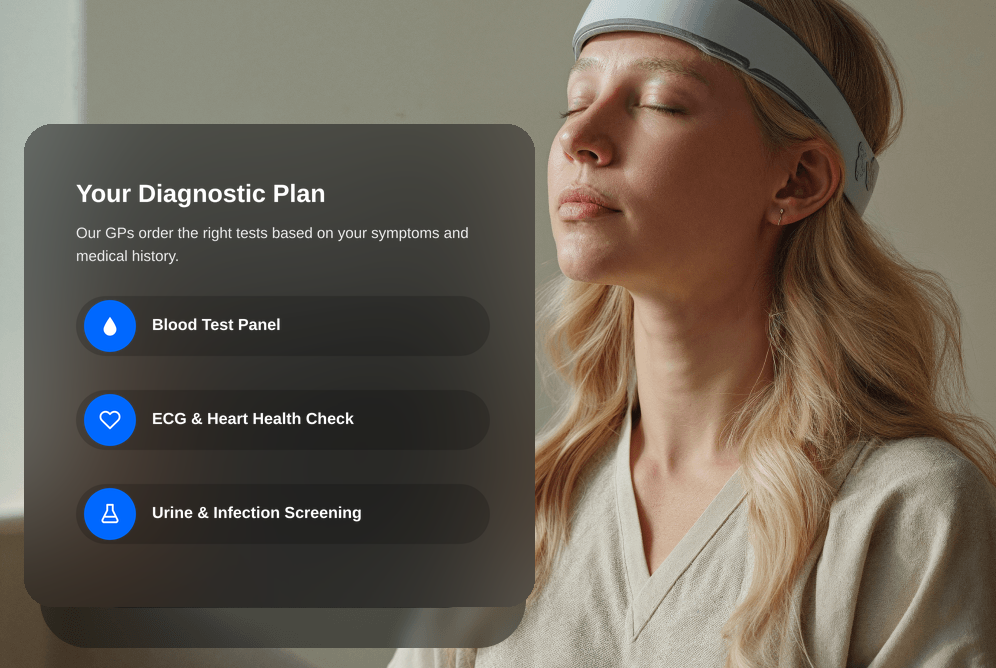
Diagnostic testing plan including blood test panel, ECG and urine screening
03

Tests and referrals, if you need them

Where testing will actually answer the question, we arrange it — blood tests and health screening through our laboratory partner, or a referral for ultrasound, X-ray, CT or MRI through private imaging providers. We will also tell you when a scan is not the right next step.
1–7 days
Personalised results and treatment plan from a private GP consultation
04

Results and next steps

Your GP talks you through what the results mean and agrees the next step with you. Every consultation ends with your treatment plan in writing, and any prescription goes to your own pharmacy.
20 minutes
GP follow-up reminder for ongoing care and progress monitoring
05

Ongoing care and follow-up

Follow-up appointments, progress monitoring and ongoing advice — including saying plainly when something needs in-person or NHS care instead.

Ongoing

How we compare

Time to be seen

Appointment length

Your NHS record in the room

Written treatment plan

Told when a test isn’t needed

Cost

Varies by practice

Typically 10 minutes

Yes, your full record

Not routinely

Usually

Free

Same day

Often 10 to 15 minutes

Usually not

Sometimes charged

Varies by provider

Often a subscription

Questions about our service

How quickly can I be seen?

Same-day access is usually available, from 6am to 10pm, seven days a week. You choose a time that suits you rather than waiting on hold at 8am.

Will I see the same doctor each time?

Yes. Care is led personally by Dr Mohammad Khan, so you are not passed between clinicians. Continuity is the point of a small practice: someone who knows your history and is listening attentively rather than working through a checklist.

Can you see my NHS records?

Yes, with your consent. We can access your Summary Care Record during the consultation, so your current medications, allergies and significant history are in the room. That means fewer questions you have already answered elsewhere, and safer prescribing.

Are you trying to replace my NHS GP?

No. We are not here to replace GPs, only to support them. Your NHS practice remains responsible for your ongoing care, and with your consent we write to them after the consultation. We are useful when you need to be seen sooner, or want more time than a standard appointment allows.

What is included in the appointment?

Twenty unhurried minutes and a comprehensive assessment. A written treatment plan is included, along with any prescription, sick note or referral letter arising from the consultation, at no extra charge.

How much does it cost?

£40 for 20 minutes, self-pay. Membership is optional and never required. Priced for fairness, because we are not here to charge extortionate amounts for access to a doctor.

What does “treatable online” actually mean?

It means the diagnosis can usually be made from your history and photographs, and that treatment can be arranged safely without examining you. Where a condition is not marked treatable online, it is because examination is the diagnosis — listening to a chest, feeling an abdomen, examining an ear or a joint — or because a procedure or device is needed.

Can you prescribe antibiotics?

Yes, where there is a genuine bacterial infection — cellulitis, impetigo, bacterial urine infections, confirmed strep throat. We will also frequently tell you that you do not need one. Most sore throats, coughs, colds and earaches are viral, and an antibiotic gives you the side effects with none of the benefit.

What if the GP cannot help with what I need?

If your problem turns out to be genuinely outside what we can do remotely, the doctor will tell you straight away, point you to the right service, and refund your fee in full. We would rather do that than fill twenty minutes to justify the charge.

What should I do in an emergency?

Call 999 or go to A&E — do not book an online appointment and do not wait for a reply to an email. For urgent problems that are not emergencies, NHS 111 is available 24 hours a day, online or by phone, and can direct you to the right service.

Patient reviews

What our patients say

No reviews published yet.
Ready to see a GP?20 minutes with a GMC-registered doctor. £40, usually same day.
Book a consultation