Home

/

NHS screening

/

NHS Health Check

NHS Health Check

Free every five years from 40 to 74 in England. Covers much of what a paid panel does, and fewer than half of those invited take it up.

40 to 74, for people without an existing related condition

Every 5 years

England only — Scotland, Wales and Northern Ireland have different arrangements

NHS screening is free — this page explains it, we do not sell it

Honest about who benefits and who may be harmed

A GP to talk through a result, a recall or a missed invitation

Your NHS records in the room, with your consent

Clinically reviewed by Dr Mohammad Khan · Last reviewed

August 30, 2026

Talk it through with a GP

Screening itself is free on the NHS. If you want a result explained, have been recalled, or missed an invitation and are not sure what to do, a 20-minute appointment with a GMC-registered GP is £40. Same-day appointments are usually available, 6am to 10pm, seven days a week.

Private GP care led personally by Dr Mohammad Zubair Khan, GMC 7563469.

Why patients choose Cheshire Clinics

GMC registered doctors badge - every Cheshire Clinics consultation is with a General Medical Council registered GP

GMC-registered

Care led personally by Dr Khan

Royal College of General Practitioners badge - RCGP trained private GP consultations at Cheshire Clinics

RCGP-trained

Attentive, unhurried care that listens properly

Google five star reviews badge - Cheshire Clinics private GP online

Highly rated by patients

Five-star Google reviews from the people we have looked after

Care Quality Commission registered badge - Cheshire Clinics online GP service is registered with the CQC, England's independent regulator of health and social care

CQC-registered

Registered with the Care Quality Commission

Same-Day Appointments
Sick Notes
Private Prescriptions
Blood Tests
Menopause & HRT
Weight Management
Mental Health
Specialist Referrals
Same-Day Appointments
Sick Notes
Private Prescriptions
Blood Tests
Menopause & HRT
Weight Management
Mental Health
Specialist Referrals

Who is invited

Adults in England aged 40 to 74, once every five years, who do not already have one of the conditions the check is designed to find.

Who is excluded, and why that is sensible

You are not invited if you already have cardiovascular disease, diabetes, chronic kidney disease, high blood pressure being treated, atrial fibrillation, heart failure, a previous stroke or TIA, or familial hypercholesterolaemia.

That is not an oversight. If you have any of those, you should already be having annual reviews that cover the same ground and more — and being told your risk of developing a condition you already have would be meaningless.

England only

This is an England programme. Scotland, Wales and Northern Ireland have their own, differently structured arrangements, and the equivalent may be offered through your GP rather than as a named national programme.

If you are in Wales, ask your practice what is available locally rather than looking for an "NHS Health Check" by that name.

How you are invited

Usually a letter from your GP practice, though in some areas it is delivered by pharmacies, community providers or in leisure centres.

You can also ask. If you are in the age range, have not been invited, and think you are due, ring your practice — invitation systems are imperfect and asking often works.

A caveat worth stating

Provision has become uneven. Some areas have reduced or paused the programme, and uptake varies widely. If your practice says it is not currently offering them, that is a local commissioning position rather than you being ineligible.

What happens

The appointment

Twenty to thirty minutes, usually with a nurse or healthcare assistant.

  • Height, weight and BMI, sometimes waist measurement
  • Blood pressure
  • Cholesterol — often a finger-prick test, sometimes a blood sample
  • Questions about family history, smoking, alcohol, diet and physical activity
  • Blood sugar, where your other results suggest it is warranted
  • A dementia awareness discussion if you are 65 to 74

What comes out of it

A cardiovascular risk score — usually QRISK — estimating your chance of a heart attack or stroke in the next ten years, and a conversation about what to do with it.

Depending on the results, that might mean:

  • A discussion about starting a statin, typically where your ten-year risk is 10% or more
  • Treatment for high blood pressure, or home monitoring to confirm it
  • Referral to the NHS Diabetes Prevention Programme if your blood sugar is in the prediabetes range
  • Referral to stop smoking or weight management services, both free
  • Further blood tests for kidney function or diabetes
  • Nothing at all, which is a legitimate and common outcome

Newer formats

A digital version and postal cholesterol testing are being introduced in some areas, which removes the appointment barrier for people who cannot easily get to a surgery in working hours. Worth asking whether it is available locally.

Why it matters

The conditions this check looks for are all silent, all common, and all treatable.

  • High blood pressure — affects around a third of UK adults, causes no symptoms, and is one of the leading preventable causes of stroke. A large number of people with it do not know
  • Prediabetes — common, reversible, and picked up here in people who feel entirely well
  • Chronic kidney disease — silent until advanced
  • Atrial fibrillation — sometimes detected when the pulse is felt, and a major and very treatable cause of stroke
  • High cholesterol, in the context of overall risk rather than as a number alone

What makes it worth the twenty minutes

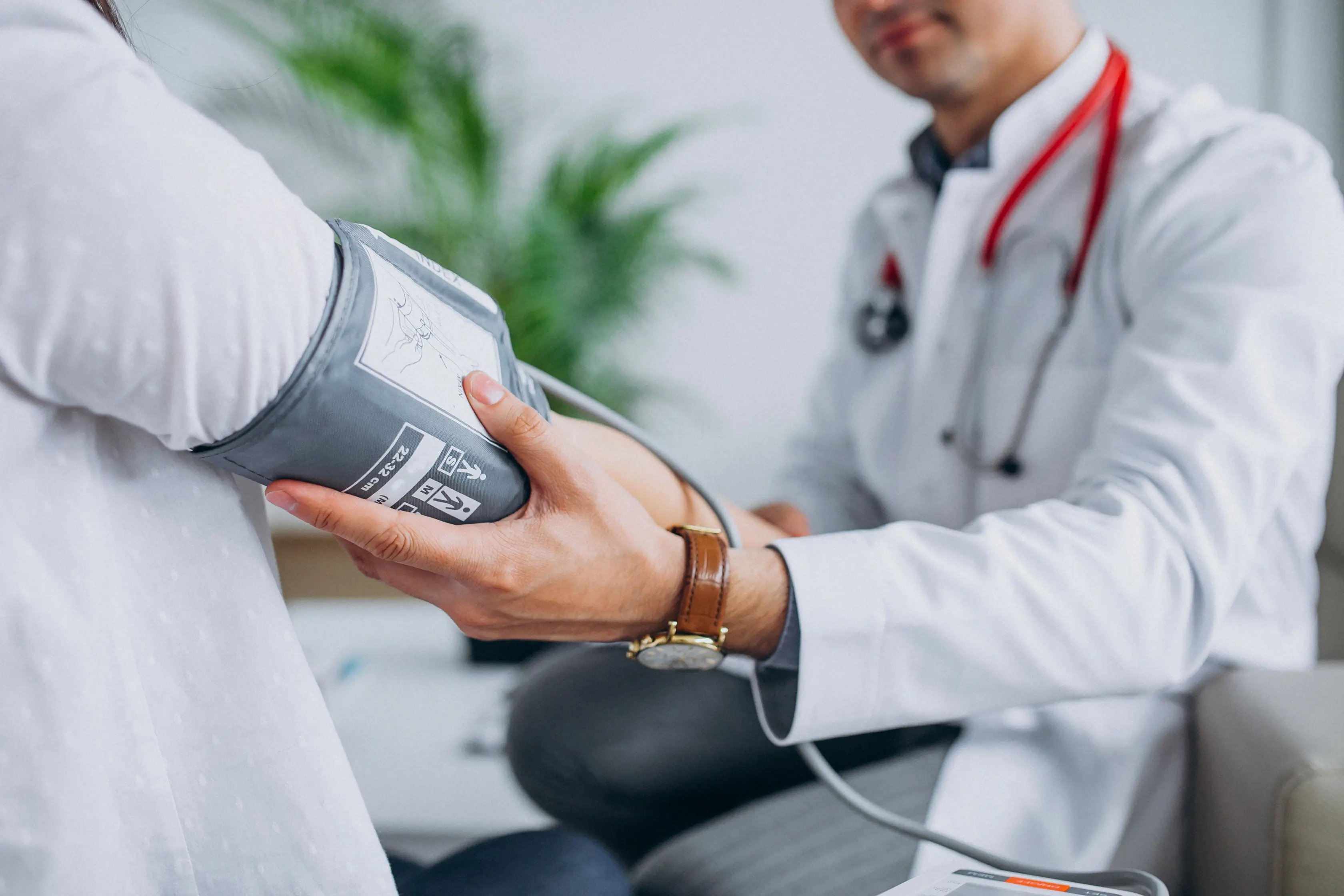
Blood pressure is the single most valuable measurement here, and it is one we cannot take remotely. Finding and treating it prevents strokes in people who would otherwise have had no warning at all.

That one measurement justifies the appointment even if everything else is normal.

Had a result or an invitation you want explained?

Book a consultation

What the evidence shows

This is where we have to be careful, because the evidence is genuinely more mixed than for the cancer screening programmes.

The uncomfortable part

Systematic reviews of general health checks in adults have not shown a reduction in overall mortality or cardiovascular mortality. That finding is well established and it applies to the broad "health MOT" concept.

We say the same thing on our own paid screening pages, and it would be inconsistent to suppress it here.

The part that supports it

  • The NHS Health Check is narrower than a general health check — it targets cardiovascular risk specifically, in a defined age band, with defined actions attached to defined results
  • Evaluations have found it identifies undiagnosed hypertension, diabetes and chronic kidney disease in people who had no idea
  • It increases statin prescribing and antihypertensive prescribing in people at genuine risk, both of which have strong trial evidence behind them
  • Attenders show modest improvements in cholesterol, blood pressure and weight compared with non-attenders

The honest summary

It is better than a general health check, weaker than the cancer screening programmes, and free.

Its value depends almost entirely on what happens afterwards — whether the blood pressure gets treated, whether the prevention programme referral is taken up. A risk score that changes nothing is worth nothing.

Reviewed against UK Health Security Agency, NHS England Health Check programme guidance and NICE guidance current at the date shown above.

Uptake and barriers

The numbers

Fewer than half of invited people take it up — consistently the lowest uptake of any programme on this list.

Who attends least

  • Men, and men in their forties in particular
  • People in more deprived areas, who have the highest cardiovascular risk. The programme reaches the people who need it least, most
  • People in work, for whom a daytime appointment is genuinely difficult
  • Younger people in the age band, who assume it is for the old

The reasons, and the answers

  • "I feel fine." Every one of the conditions this looks for is silent. That is the whole design
  • "I can't get time off." Ask about early, late, weekend or pharmacy-delivered checks, and about the digital or postal versions now appearing
  • "It's just a lecture about my weight." A fair complaint, and a poor version of the check is exactly that. A good one gives you a number, explains what it means, and offers something concrete
  • "I'd rather not know." Understandable — and worth weighing against the fact that high blood pressure treated at 45 prevents a stroke at 60
  • "Nobody invited me." Ring and ask. Invitation systems miss people routinely

If you are put off by how it is delivered

You are entitled to ask for the numbers rather than only the advice. Your actual blood pressure reading, your actual cholesterol figures, and your actual QRISK score are yours, and they are more useful than a leaflet.

If you miss it

Getting one

  • Ring your GP practice and ask. You do not have to wait for a letter if you are in the age range and due
  • Check whether your area offers it through pharmacies or community venues, which is often easier than a surgery appointment
  • Ask about the digital or postal versions if getting there is the obstacle

If your area has stopped offering them

The individual components are still available. You can:

  • Get your blood pressure checked free at a pharmacy, without an appointment, if you are over 40. This is the single most valuable part and it takes five minutes
  • Ask your GP for a cholesterol and HbA1c test if you have risk factors
  • Use a home blood pressure monitor, which costs less than a private panel and gives better information than a single reading in a surgery

Symptoms are a different pathway

This is a check for people who feel well. If you have chest pain, breathlessness on exertion, palpitations, or any symptom that concerns you, that needs assessing now rather than at a routine check.

Chest pain with sweating, nausea, or pain spreading to the arm or jaw is 999, immediately.

Limitations and harms

What it is not

It is not a full health MOT, and calling it one sets the wrong expectation. It does not check for:

  • Cancer of any kind
  • Thyroid disease, anaemia, B12 deficiency or liver disease, unless something prompts a further test
  • Your eyes, hearing, skin, bones or mental health, beyond a brief conversation
  • Anything at all outside cardiovascular and metabolic risk

The harms

  • False reassurance. The commonest harm, and the most important. A normal check means your cardiovascular risk looks acceptable today — it does not mean you have been screened for anything else, and a new symptom next month still needs acting on
  • Anxiety from a risk score, which is a probability rather than a prediction and is easily misread as a diagnosis
  • Medicalising people who feel well, including starting lifelong medication on the basis of a calculated risk
  • Borderline results leading to further testing that finds nothing

On the risk score itself

Age drives QRISK more than anything else you can change. A man of 70 with entirely normal cholesterol and blood pressure will often exceed the 10% threshold purely on age.

That is worth understanding before a statin conversation, because "your risk is over 10%" can sound like something is wrong when it may simply mean you are 70.

The balance

It is free, it is brief, and it finds treatable silent conditions in a meaningful number of people. The evidence that it saves lives at population level is weaker than for bowel or cervical screening, and we would rather say so.

Our honest advice: take it, ask for your actual numbers, and act on the blood pressure.

Common questions

Is it worth doing?

Yes, largely because of blood pressure. It is free, brief, and finds silent, treatable conditions.

The evidence that general health checks reduce deaths is weak, and we will not pretend otherwise — but a stroke prevented by treating hypertension found at 45 is a real benefit.

Why have I not been invited?

Either you are outside 40 to 74, you already have a condition that excludes you, or the invitation system has missed you.

Ring your practice and ask — the third of those is common.

Why am I excluded if I have diabetes?

Because you should already be having annual reviews that cover the same ground and more.

If you are not getting those reviews, that is the thing to chase — they are more thorough than this check.

Is this the same as a private health screen?

It covers much of the same ground for the things that matter most — blood pressure, cholesterol, diabetes risk, weight.

A private panel adds more blood markers, which sounds like more but does not necessarily mean better. It also cannot measure your blood pressure if it is done remotely.

My risk score was over 10%. Do I have to take a statin?

No. It is an offer and a conversation, not an instruction.

Bear in mind that age drives the score heavily — a 70-year-old with perfect numbers often crosses 10% on age alone. That context matters before deciding.

What is the most useful part?

The blood pressure reading. High blood pressure is common, entirely silent, and one of the most treatable causes of stroke.

If you do nothing else, get your blood pressure checked — free at many pharmacies, no appointment, five minutes.

Does it check for cancer?

No, not at all. It is a cardiovascular and metabolic risk check.

Cancer screening is entirely separate — bowel, breast and cervical programmes, each with their own invitations.

I live in Wales. Where is mine?

The NHS Health Check is an England programme. The other UK nations have their own, differently structured arrangements.

Ask your GP practice what is offered locally rather than looking for this by name.

My check was normal. Am I fine?

Your cardiovascular risk looked acceptable on that day. That is genuinely useful and it is not a clean bill of health.

It says nothing about cancer, thyroid, bones or anything else, and a new symptom next month still needs assessing on its own merits.

My area has stopped doing them. What now?

Get the individual pieces. A free pharmacy blood pressure check is the highest-value part and needs no appointment.

Ask your GP for cholesterol and HbA1c if you have risk factors, and consider a home blood pressure monitor — cheaper than a private panel and more informative.

Dr Mohammad Zubair Khan, GMC-registered private GP and founder of Cheshire Clinics

Clinically reviewed by Dr Mohammad Zubair Khan, GMC 7563469

Last reviewed

August 30, 2026

How it works

What happens when you book

£40 for a 20-minute appointment with a GMC-registered GP, 6am to 10pm, seven days a week. Membership is optional and never required.
Cheshire Clinics online GP appointment booking confirmation on mobile
01

Book your appointment

Pick a time that suits you — 6am to 10pm, seven days a week, including weekends and bank holidays. £40 for 20 minutes, self-pay, with no insurance to arrange.
5–10 minutes
Online video consultation with a GMC-registered private GP
02

Meet your GP

A 20-minute video or phone consultation with a GMC-registered GP — long enough for a proper conversation about your symptoms, your history and what matters to you.
20 minutes
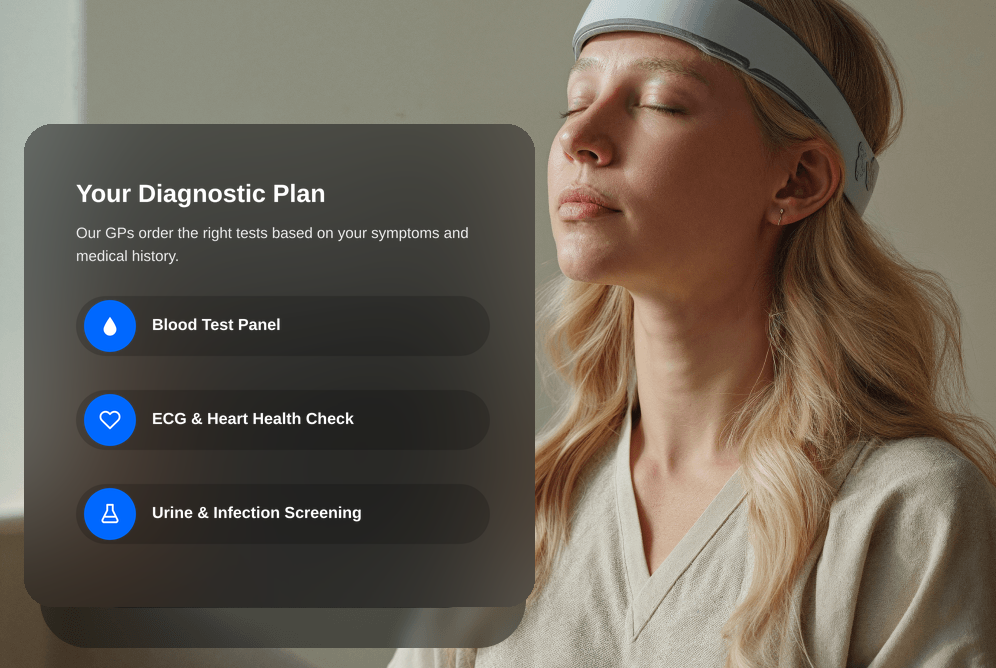
Diagnostic testing plan including blood test panel, ECG and urine screening
03

Tests and referrals, if you need them

Where testing will actually answer the question, we arrange it — blood tests and health screening through our laboratory partner, or a referral for ultrasound, X-ray, CT or MRI through private imaging providers. We will also tell you when a scan is not the right next step.
1–7 days
Personalised results and treatment plan from a private GP consultation
04

Results and next steps

Your GP talks you through what the results mean and agrees the next step with you. Every consultation ends with your treatment plan in writing, and any prescription goes to your own pharmacy.
20 minutes
GP follow-up reminder for ongoing care and progress monitoring
05

Ongoing care and follow-up

Follow-up appointments, progress monitoring and ongoing advice — including saying plainly when something needs in-person or NHS care instead.

Ongoing

How we compare

Time to be seen

Appointment length

Your NHS record in the room

Written treatment plan

Told when a test isn’t needed

Cost

Varies by practice

Typically 10 minutes

Yes, your full record

Not routinely

Usually

Free

Same day

Often 10 to 15 minutes

Usually not

Sometimes charged

Varies by provider

Often a subscription

Questions about our service

How quickly can I be seen?

Same-day access is usually available, from 6am to 10pm, seven days a week. You choose a time that suits you rather than waiting on hold at 8am.

Will I see the same doctor each time?

Yes. Care is led personally by Dr Mohammad Khan, so you are not passed between clinicians. Continuity is the point of a small practice: someone who knows your history and is listening attentively rather than working through a checklist.

Can you see my NHS records?

Yes, with your consent. We can access your Summary Care Record during the consultation, so your current medications, allergies and significant history are in the room. That means fewer questions you have already answered elsewhere, and safer prescribing.

Are you trying to replace my NHS GP?

No. We are not here to replace GPs, only to support them. Your NHS practice remains responsible for your ongoing care, and with your consent we write to them after the consultation. We are useful when you need to be seen sooner, or want more time than a standard appointment allows.

What is included in the appointment?

Twenty unhurried minutes and a comprehensive assessment. A written treatment plan is included, along with any prescription, sick note or referral letter arising from the consultation, at no extra charge.

How much does it cost?

£40 for 20 minutes, self-pay. Membership is optional and never required. Priced for fairness, because we are not here to charge extortionate amounts for access to a doctor.

What does “treatable online” actually mean?

It means the diagnosis can usually be made from your history and photographs, and that treatment can be arranged safely without examining you. Where a condition is not marked treatable online, it is because examination is the diagnosis — listening to a chest, feeling an abdomen, examining an ear or a joint — or because a procedure or device is needed.

Can you prescribe antibiotics?

Yes, where there is a genuine bacterial infection — cellulitis, impetigo, bacterial urine infections, confirmed strep throat. We will also frequently tell you that you do not need one. Most sore throats, coughs, colds and earaches are viral, and an antibiotic gives you the side effects with none of the benefit.

What if the GP cannot help with what I need?

If your problem turns out to be genuinely outside what we can do remotely, the doctor will tell you straight away, point you to the right service, and refund your fee in full. We would rather do that than fill twenty minutes to justify the charge.

What should I do in an emergency?

Call 999 or go to A&E — do not book an online appointment and do not wait for a reply to an email. For urgent problems that are not emergencies, NHS 111 is available 24 hours a day, online or by phone, and can direct you to the right service.

Patient reviews

What our patients say

No reviews published yet.
Ready to see a GP?20 minutes with a GMC-registered doctor. £40, usually same day.
Book a consultation