Home

/

NHS screening

/

Bowel Cancer Screening

Bowel Cancer Screening

A home kit through the post, one sample, two minutes. Proven to reduce deaths, and around a third are never returned.

From 50 to 74 in most of the UK, and available on request beyond 74

Every 2 years

England, Scotland, Wales and Northern Ireland — starting ages differ and are being lowered

NHS screening is free — this page explains it, we do not sell it

Honest about who benefits and who may be harmed

A GP to talk through a result, a recall or a missed invitation

Your NHS records in the room, with your consent

Clinically reviewed by Dr Mohammad Khan · Last reviewed

August 30, 2026

Talk it through with a GP

Screening itself is free on the NHS. If you want a result explained, have been recalled, or missed an invitation and are not sure what to do, a 20-minute appointment with a GMC-registered GP is £40. Same-day appointments are usually available, 6am to 10pm, seven days a week.

Private GP care led personally by Dr Mohammad Zubair Khan, GMC 7563469.

Why patients choose Cheshire Clinics

GMC registered doctors badge - every Cheshire Clinics consultation is with a General Medical Council registered GP

GMC-registered

Care led personally by Dr Khan

Royal College of General Practitioners badge - RCGP trained private GP consultations at Cheshire Clinics

RCGP-trained

Attentive, unhurried care that listens properly

Google five star reviews badge - Cheshire Clinics private GP online

Highly rated by patients

Five-star Google reviews from the people we have looked after

Care Quality Commission registered badge - Cheshire Clinics online GP service is registered with the CQC, England's independent regulator of health and social care

CQC-registered

Registered with the Care Quality Commission

Same-Day Appointments
Sick Notes
Private Prescriptions
Blood Tests
Menopause & HRT
Weight Management
Mental Health
Specialist Referrals
Same-Day Appointments
Sick Notes
Private Prescriptions
Blood Tests
Menopause & HRT
Weight Management
Mental Health
Specialist Referrals

Who is invited

You do not apply for this. A kit is posted to you automatically, to the address your GP practice holds, once you reach the starting age.

  • England — the programme has been extending downwards and now reaches people from age 50, up to 74
  • Scotland — from 50 to 74
  • Wales — currently from 51, with the starting age being lowered to 50
  • Northern Ireland — from 60, with extension planned

The starting ages have been moving, so if you are in your early fifties and have not had one, that may simply be timing rather than an error. You can check with the screening helpline for your nation.

Over 74 — the part almost nobody knows

You stop being invited automatically at 74. You do not stop being eligible.

You can request a kit every two years by calling the bowel screening helpline, and you should, because bowel cancer risk continues to rise with age. This is one of the least publicised facts in NHS screening, and a great many people simply assume the programme has finished with them.

If you are at higher risk

A strong family history, Lynch syndrome, familial adenomatous polyposis, or long-standing inflammatory bowel disease put you in a separate surveillance pathway with colonoscopies rather than home kits. That is arranged through a specialist, not through the screening programme.

What happens

The kit

A small plastic stick and a sample bottle arrive in the post with instructions. You collect a tiny amount from one bowel motion, put the stick back in the bottle, and post it in the pre-paid envelope.

One sample. One time. It takes about two minutes.

The current kit is much simpler than the old one, which needed samples from three separate occasions and put a lot of people off. If your impression of this test dates from a decade ago, it is out of date.

What it is looking for

The FIT test — faecal immunochemical test — detects tiny amounts of blood in the stool that you cannot see. Polyps and early cancers bleed intermittently long before they cause any symptoms.

The result

  • Normal — which is the outcome for around 98 in 100 people. You will be invited again in two years
  • Abnormal — blood was detected, and you will be offered a colonoscopy. Most people with an abnormal result do not have cancer; polyps, haemorrhoids and other benign causes are far commoner

Results usually arrive within two weeks.

The colonoscopy

A camera examination of the large bowel, with sedation offered. The preparation — a strong laxative the day before — is the part people find hardest, and it is worth knowing that in advance.

Polyps found during the test are usually removed there and then, which is the whole point: this is one of the few screening programmes that can prevent a cancer rather than merely detect one.

Why it matters

Bowel cancer is one of the commonest cancers in the UK and one of the most treatable when found early.

Found at the earliest stage, more than nine in ten people are alive five years later. Found at the latest stage, that figure falls to around one in ten. Very few interventions in medicine shift the odds that far.

It prevents cancer as well as finding it

Most bowel cancers begin as polyps — small growths that take years to turn malignant. A colonoscopy triggered by an abnormal FIT result removes those polyps before they ever become cancer.

That is a genuinely unusual thing for a screening programme to do. Most screening finds disease earlier; this one can stop it happening.

Why we lead with it

We are a private clinic, and we could sell you a blood panel instead. The honest position is that this free kit has better evidence behind it than anything we offer, and the highest-value thing we can do on a page like this is tell you to send it back.

Had a result or an invitation you want explained?

Book a consultation

What the evidence shows

Bowel screening is one of only a small number of screening programmes shown in randomised trials to reduce deaths from the cancer it screens for.

  • Randomised controlled trials of faecal occult blood screening demonstrated a reduction in bowel cancer mortality, and this underpins every national programme
  • FIT has replaced the older guaiac test because it is more sensitive, more specific for human blood, and needs only a single sample — which improves uptake
  • The UK National Screening Committee recommended lowering the starting age to 50, following evidence of rising incidence in younger adults
  • Colonoscopy with polypectomy reduces subsequent bowel cancer incidence, not only mortality
  • NICE DG56 supports FIT testing in symptomatic patients in primary care to guide urgent referral — a separate use from screening, and one worth distinguishing

Reviewed against UK National Screening Committee, NHS Bowel Cancer Screening Programme and NICE guidance current at the date shown above.

Uptake and barriers

The numbers

Around a third of kits are never returned. That is the central problem with this programme — not its accuracy, not its availability, but the number of them that go in the bin.

Who returns them least

  • Men, consistently less often than women
  • People in more deprived areas
  • Some minority ethnic communities, where uptake is markedly lower
  • People in their early fifties, newly eligible and least likely to think it applies to them

The reasons people give, and the answers

  • "It's unpleasant." It is one small sample, on a stick, into a sealed bottle. It takes two minutes and you do not have to look at anything
  • "I feel fine." That is precisely the point — it is designed for people with no symptoms. By the time bowel cancer causes symptoms it is usually further advanced
  • "I'd rather not know." Understandable, and worth weighing against the fact that early bowel cancer is usually curable and late bowel cancer usually is not
  • "I lost the kit." Call the helpline and they will send another. This is routine and nobody minds
  • "I meant to do it." The commonest reason of all. Do it the day it arrives

If you are helping an older relative

Asking whether they returned it, and helping them if not, is one of the more useful things you can do for someone in their seventies. It is also worth telling them they can keep requesting kits after 74.

If you miss it

You have not lost your chance

  • Kits can be reissued. Call the bowel cancer screening helpline for your nation and ask for a replacement — this is entirely routine
  • There is a time limit on each kit, but a new one can be sent
  • If you have moved, make sure your GP practice has your current address, since that is where the kit is sent

If you are over 74

Request a kit every two years by calling the helpline. You will not be invited, but you remain eligible.

If you have symptoms, do not wait for a kit

This is the most important thing on the page after "send it back".

Screening is for people with no symptoms. If you have symptoms, you need assessment now, not a screening kit.

  • Blood in your stool, or bleeding from the back passage
  • A persistent change in bowel habit, particularly looser stools
  • Unexplained weight loss
  • Persistent abdominal pain or a lump
  • Unexplained tiredness or iron deficiency anaemia

A normal screening result from last year does not exclude a cancer that has developed since. Cancers arising between screening rounds are a recognised phenomenon, and "but my test was clear" is a well-documented reason people delay.

Limitations and harms

What it does not do

  • It does not detect every bowel cancer. Some do not bleed at the moment you take the sample, and those are missed
  • A normal result is not a clean bill of health for the next two years. Symptoms developing in between still need acting on
  • It says nothing about any other cancer

The harms, stated properly

  • False positives. Most abnormal results are not cancer, but they lead to a colonoscopy — with bowel preparation, time off work, anxiety, and a small risk of bleeding or perforation from the procedure itself
  • False negatives, which can cause false reassurance and delay
  • Finding polyps that would never have caused harm, and removing them anyway. This is a genuine cost, though a modest one compared with most screening programmes

The balance

For bowel screening, the balance of benefit to harm is more clearly favourable than for most screening programmes. That is not true of everything the NHS screens for, and we say so on the pages where it is not.

Here, the evidence is good, the harms are modest, and the main problem is that people do not do it.

Common questions

How do I get a kit?

You do not have to do anything — it is posted to you automatically once you reach the starting age, to the address your GP holds.

If you have moved recently, check your practice has your current address.

I threw it away. Can I get another?

Yes, and this happens constantly. Call the bowel screening helpline for your nation and ask for a replacement.

Nobody will think anything of it — it is a routine request.

How unpleasant is it, honestly?

Less than you think. One small sample, collected on a plastic stick, sealed into a bottle. Two minutes.

The old test needed three separate samples and was genuinely off-putting. If that is what you are remembering, the current one is much easier.

I feel completely fine. Why would I do it?

Because that is exactly who it is for. The test is designed to find cancers and polyps before they cause anything at all.

By the time bowel cancer produces symptoms, it is usually more advanced and harder to treat.

My result was abnormal. Do I have cancer?

Probably not. Most people with an abnormal result turn out to have polyps, haemorrhoids or another benign cause.

It means a colonoscopy is needed to find out — and if polyps are found, removing them prevents a future cancer.

What is a colonoscopy actually like?

A camera examination of the bowel, with sedation offered. Most people find the procedure itself easier than they expected.

The preparation the day before — a strong laxative — is the difficult part, and it is worth planning a day at home for it.

I am 76 and I have stopped getting kits. Is that it?

No — and this catches almost everybody out. Automatic invitations stop at 74, but you remain eligible.

Call the helpline and request a kit every two years. Risk rises with age, so this matters more, not less.

My test was clear last year but I am bleeding now. Should I wait?

No. Get assessed now. A clear screening result does not exclude something that has developed since.

Symptoms and screening are separate pathways, and treating a past normal result as reassurance is a recognised cause of delayed diagnosis.

Should I pay for a private test instead?

No. There is nothing on the private market that improves on this, and anything sold as an alternative to bowel screening should be treated with suspicion.

The free kit has better evidence behind it than any blood panel we could offer you.

Does a family history change anything?

It might. A strong family history or a known genetic condition puts you in a separate surveillance pathway with colonoscopies rather than home kits.

That is worth raising with a GP rather than assuming the standard programme covers you.

Dr Mohammad Zubair Khan, GMC-registered private GP and founder of Cheshire Clinics

Clinically reviewed by Dr Mohammad Zubair Khan, GMC 7563469

Last reviewed

August 30, 2026

How it works

What happens when you book

£40 for a 20-minute appointment with a GMC-registered GP, 6am to 10pm, seven days a week. Membership is optional and never required.
Cheshire Clinics online GP appointment booking confirmation on mobile
01

Book your appointment

Pick a time that suits you — 6am to 10pm, seven days a week, including weekends and bank holidays. £40 for 20 minutes, self-pay, with no insurance to arrange.
5–10 minutes
Online video consultation with a GMC-registered private GP
02

Meet your GP

A 20-minute video or phone consultation with a GMC-registered GP — long enough for a proper conversation about your symptoms, your history and what matters to you.
20 minutes
Diagnostic testing plan including blood test panel, ECG and urine screening
03

Tests and referrals, if you need them

Where testing will actually answer the question, we arrange it — blood tests and health screening through our laboratory partner, or a referral for ultrasound, X-ray, CT or MRI through private imaging providers. We will also tell you when a scan is not the right next step.
1–7 days
Personalised results and treatment plan from a private GP consultation
04

Results and next steps

Your GP talks you through what the results mean and agrees the next step with you. Every consultation ends with your treatment plan in writing, and any prescription goes to your own pharmacy.
20 minutes
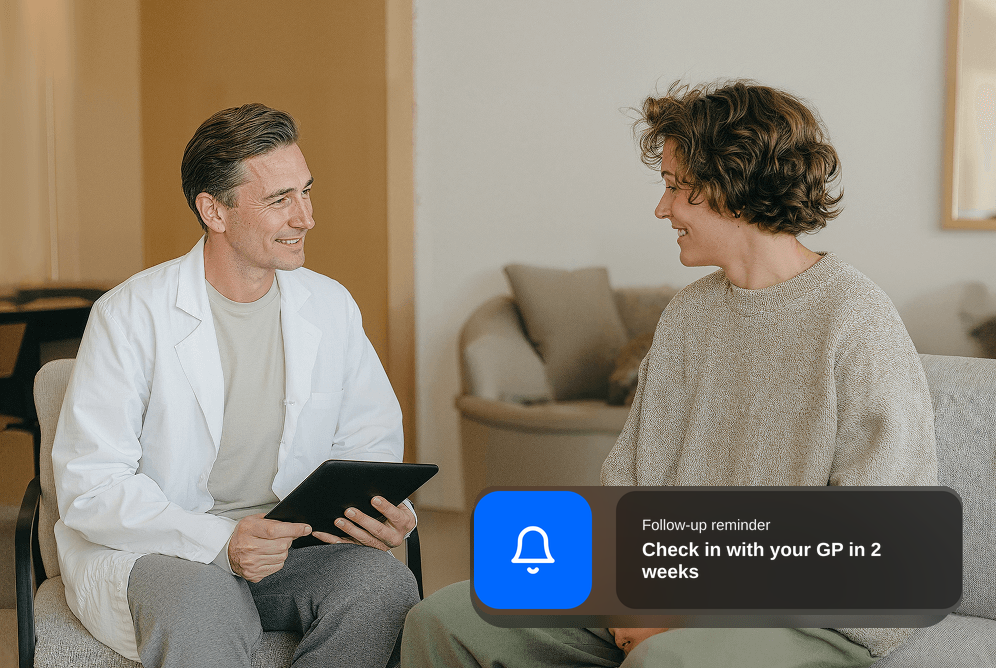
GP follow-up reminder for ongoing care and progress monitoring
05

Ongoing care and follow-up

Follow-up appointments, progress monitoring and ongoing advice — including saying plainly when something needs in-person or NHS care instead.

Ongoing

How we compare

Time to be seen

Appointment length

Your NHS record in the room

Written treatment plan

Told when a test isn’t needed

Cost

Varies by practice

Typically 10 minutes

Yes, your full record

Not routinely

Usually

Free

Same day

Often 10 to 15 minutes

Usually not

Sometimes charged

Varies by provider

Often a subscription

Questions about our service

How quickly can I be seen?

Same-day access is usually available, from 6am to 10pm, seven days a week. You choose a time that suits you rather than waiting on hold at 8am.

Will I see the same doctor each time?

Yes. Care is led personally by Dr Mohammad Khan, so you are not passed between clinicians. Continuity is the point of a small practice: someone who knows your history and is listening attentively rather than working through a checklist.

Can you see my NHS records?

Yes, with your consent. We can access your Summary Care Record during the consultation, so your current medications, allergies and significant history are in the room. That means fewer questions you have already answered elsewhere, and safer prescribing.

Are you trying to replace my NHS GP?

No. We are not here to replace GPs, only to support them. Your NHS practice remains responsible for your ongoing care, and with your consent we write to them after the consultation. We are useful when you need to be seen sooner, or want more time than a standard appointment allows.

What is included in the appointment?

Twenty unhurried minutes and a comprehensive assessment. A written treatment plan is included, along with any prescription, sick note or referral letter arising from the consultation, at no extra charge.

How much does it cost?

£40 for 20 minutes, self-pay. Membership is optional and never required. Priced for fairness, because we are not here to charge extortionate amounts for access to a doctor.

What does “treatable online” actually mean?

It means the diagnosis can usually be made from your history and photographs, and that treatment can be arranged safely without examining you. Where a condition is not marked treatable online, it is because examination is the diagnosis — listening to a chest, feeling an abdomen, examining an ear or a joint — or because a procedure or device is needed.

Can you prescribe antibiotics?

Yes, where there is a genuine bacterial infection — cellulitis, impetigo, bacterial urine infections, confirmed strep throat. We will also frequently tell you that you do not need one. Most sore throats, coughs, colds and earaches are viral, and an antibiotic gives you the side effects with none of the benefit.

What if the GP cannot help with what I need?

If your problem turns out to be genuinely outside what we can do remotely, the doctor will tell you straight away, point you to the right service, and refund your fee in full. We would rather do that than fill twenty minutes to justify the charge.

What should I do in an emergency?

Call 999 or go to A&E — do not book an online appointment and do not wait for a reply to an email. For urgent problems that are not emergencies, NHS 111 is available 24 hours a day, online or by phone, and can direct you to the right service.

Patient reviews

What our patients say

No reviews published yet.
Ready to see a GP?20 minutes with a GMC-registered doctor. £40, usually same day.
Book a consultation